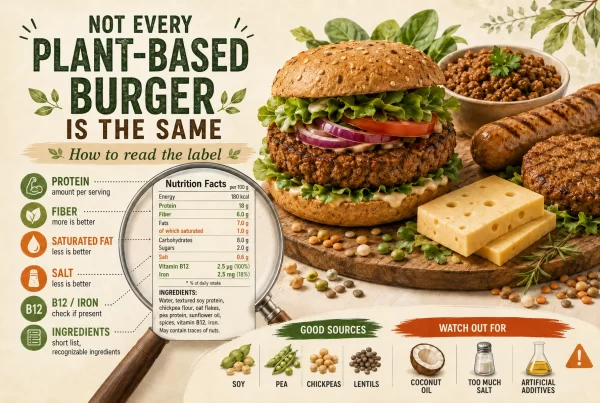

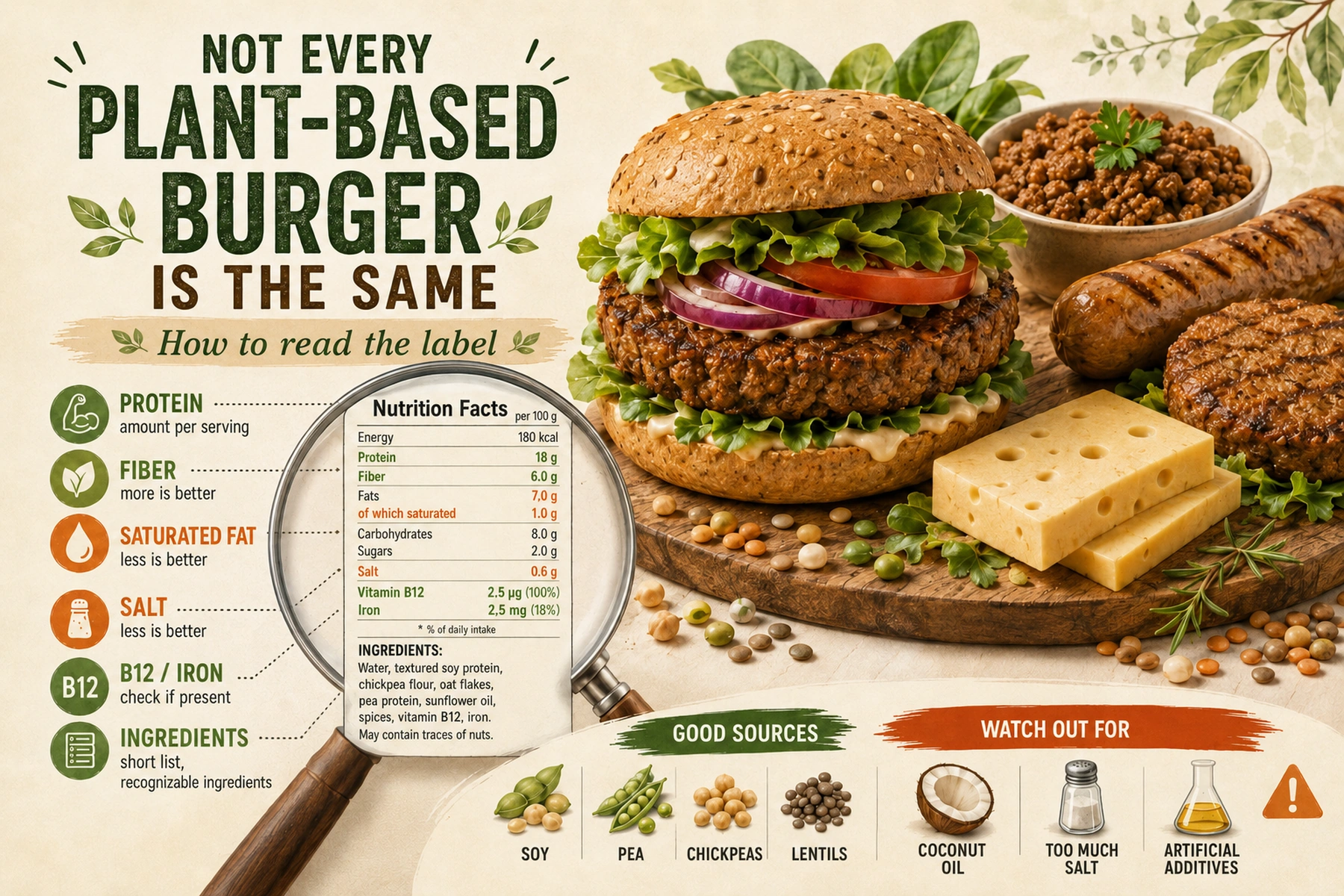
- The ingredient list is just as important as the nutrition table.
- Good signs are clear protein sources.
- Weaker signs are products that start with water, starch, coconut oil, palm oil, flavorings, colorings, and a lot of salt.
- Additives are not automatically a problem
- “Ultra-processed” does not automatically mean worse
- A well-formulated plant-based product can be useful
- Low-quality plant-based imitations are not an improvement.
- Different categories of substitutes are not the same.
- Burgers and plant-based mince can be a good choice.
- Plant-based sausages, salami, and processed meats are often better than animal versions in terms of saturated fat.
- Plant-based “chicken”, fish, and seafood alternatives should be checked carefully.
- The simplest rule is: do not trust only the front of the package.
What to Look for in the Ingredient List
The nutrition table is important, but the ingredient list also says a lot.
The first 3–5 ingredients usually show what the product really is.
Better signs:
- soy protein
- pea protein
- wheat gluten
- mycoprotein
- lentils
- beans
- chickpeas
- textured plant protein
- a combination of legume and grain proteins
- added fiber
- rapeseed, olive, or sunflower oil in reasonable amounts
Weaker signs:
- water
- starch
- coconut oil
- palm oil
- flavorings
- colorings
- a lot of salt
- a very long list of stabilizers
- little or no real protein source
The problem is not only that there are additives.
The problem is when the product has:
- many additives
- a lot of salt
- little protein
- a lot of saturated fat
- no fiber
- no fortification
Then “plant-based” no longer sounds that impressive.
Are substitutes ultra-processed, and is that a problem?
Many modern plant-based substitutes fall into the category of ultra-processed foods.
That is true.
But the answer is not as simple as it seems.
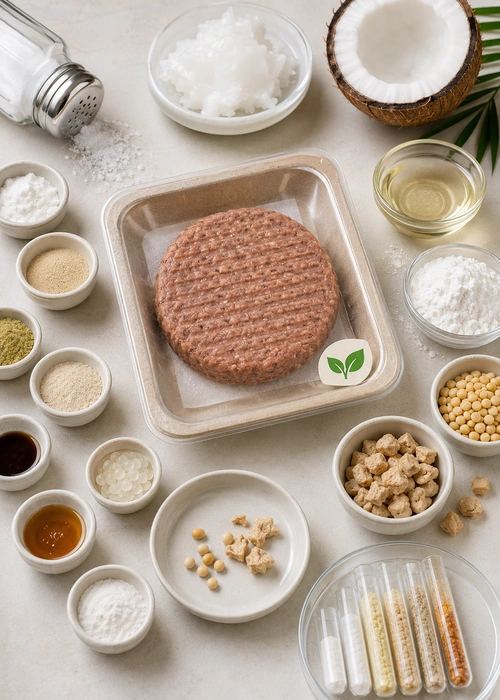
The category “ultra-processed foods” is very broad. It can include sugar-sweetened drinks, sweets, and processed meats, but also plant-based milks, meat substitutes, and modern margarines.
This does not mean that all these products have the same effect on health.
One plant-based burger may be ultra-processed but still contain:
- less saturated fat than meat
- no cholesterol
- more fiber
- a better fat profile
- a smaller environmental footprint
- a decent amount of protein
Another may be ultra-processed and contain:
- a lot of salt
- a lot of coconut oil
- little protein
- almost no fiber
- a lot of starch
- no fortification
That is why the question is not only:
Is it processed?
But:
What does it contain and what does it replace?
If a plant-based product with a good profile replaces a fatty sausage, bacon, or red meat, this can be a useful step.
However, if a person replaces beans, lentils, tofu, and whole foods with low-quality plant-based imitations, that is not an improvement.
The best approach is:
Whole plant foods should be the foundation.
Well-chosen substitutes can be a convenient tool.
Different Categories Are Not the Same
One of the biggest mistakes is to talk about all plant-based substitutes as if they were the same thing.
A plant-based burger, plant-based sausage, plant-based “chicken”, plant-based fish, and plant-based cheese can have completely different nutritional profiles.
Burgers and Mince
These are some of the most popular substitutes.
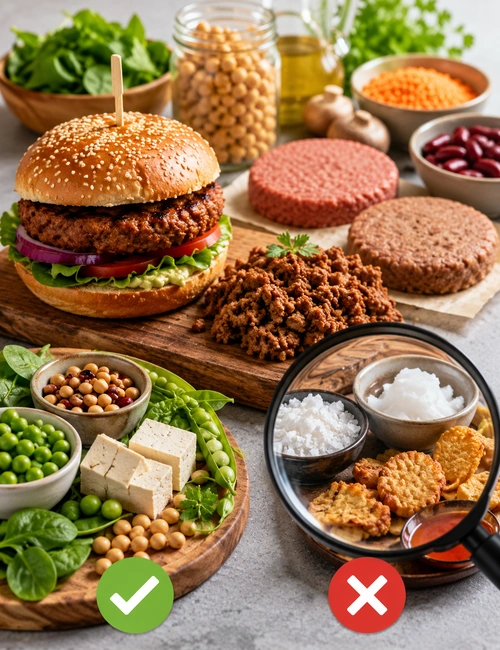
They can be a good option if they have:
- enough protein
- fiber
- low saturated fat
- salt under control
- a good protein source
But we need to be careful with products that are very salty or rich in coconut oil.
With plant-based mince, protein also needs to be checked. Some products are good. Others are more texture than nutritional value. In other words, we should not look only at the package or the appearance of the product, but at what is inside it.
Sausages, Salami, and Processed Meats
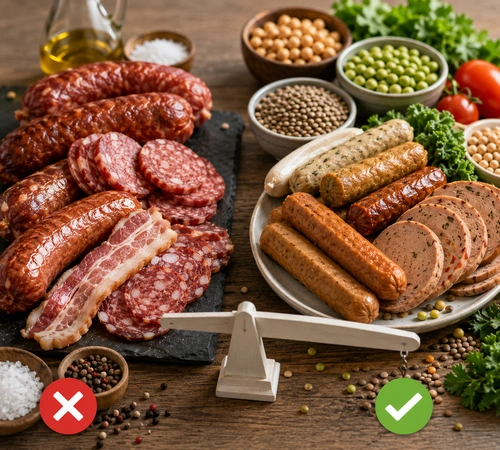
Here the comparison is interesting.
Plant-based versions often have less saturated fat than animal-based processed meats. That is a plus.
But they still remain highly processed and often salty products.
So a plant-based sausage may be a better choice than a fatty animal-based sausage, but that does not automatically turn it into an everyday healthy food.
It is better to see it as a convenient substitute from time to time, not as the foundation of the diet.
“Chicken” Alternatives
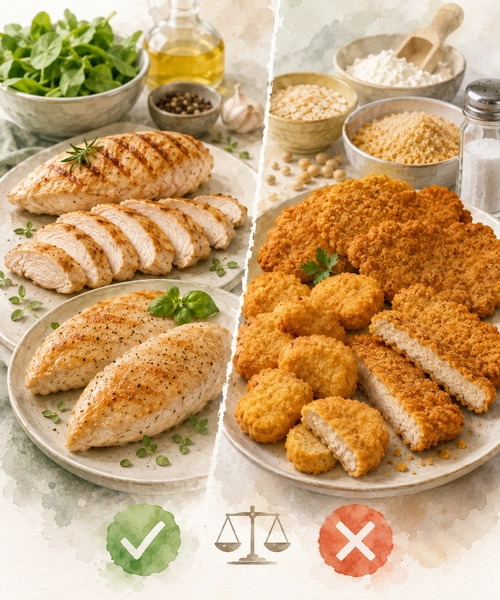
Plant-based chicken nuggets, fillets, and schnitzels are not always nutritionally better than chicken meat.
They often have:
- less protein
- more carbohydrates
- more salt
- sometimes more calories, especially if breaded
This does not mean they are bad. It simply means we should not automatically assume that “plant-based chicken” is better than chicken.
The label decides.
Fish and Seafood Alternatives
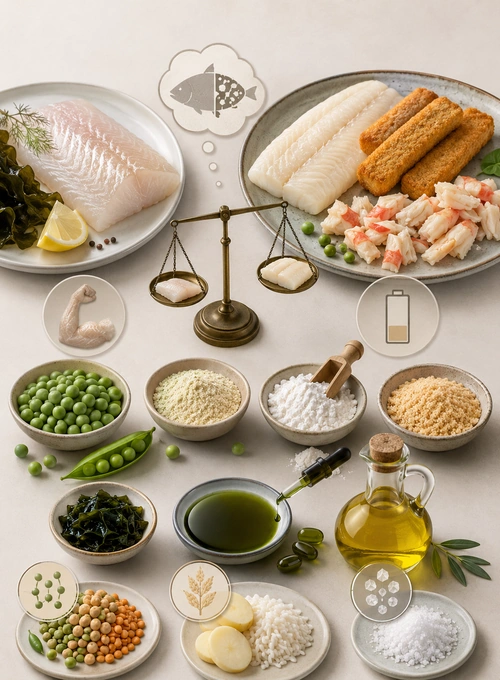
This is one of the categories where we need to be especially careful.
Many plant-based fish substitutes imitate taste, shape, or texture, but nutritionally they do not always replace fish well.
They are often:
- low in protein
- higher in carbohydrates
- saltier
- without omega-3 DHA/EPA, unless specially fortified with algae
If a person is looking for a fish substitute because of omega-3, they need to check whether the product actually contains DHA/EPA or whether it only looks like fish.
Plant-Based Cheeses
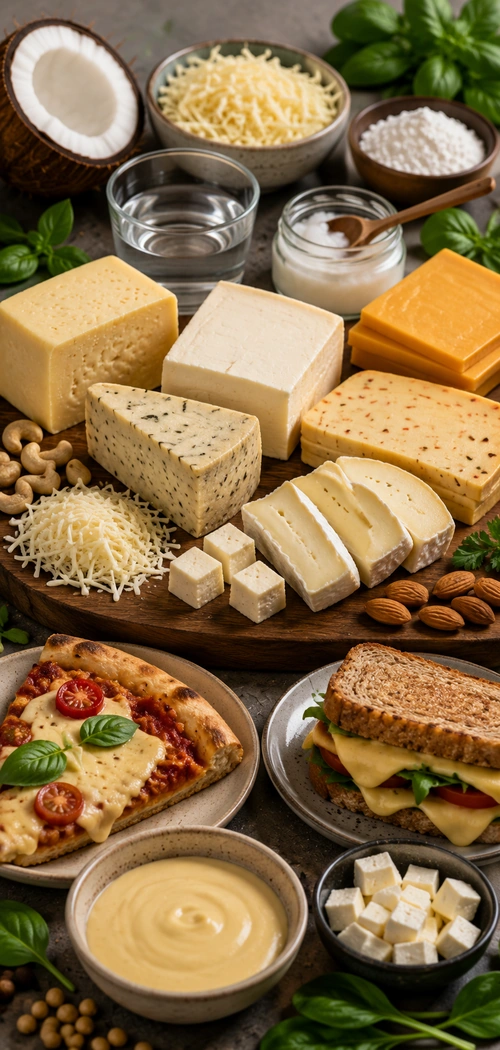
Here we need to be the most careful.
Many plant-based cheeses are not a good source of protein. Some of them are mainly a combination of:
- coconut oil
- starch
- water
- salt
- flavorings
They can be useful for taste, for pizza, sandwiches, or as a transition toward fewer dairy products. But nutritionally, they are often not equivalent to cheese, especially if they are not fortified with calcium and B12.
With plant-based cheeses, we check especially carefully:
- protein
- saturated fat
- calcium
- B12
- salt
- coconut oil
If the product has almost no protein, a lot of saturated fat, and no calcium, it is more of a culinary substitute, not a nutritional substitute.
Practical Checklist: How to Choose a Better Meat Substitute
The next time you pick up a plant-based burger, mince, or sausage, do not look only at the front of the package.
Turn it around.
And check the following:
-
Protein
It is good for the product to have at least:
- 12–15 g protein per 100 g
- If it has more than 15 g, even better.
- If it has 5–8 g and claims to replace meat, that is a weak sign.
-
Fiber
Look for at least:
- 3 g fiber per 100 g
- More is good, as long as the product does not compensate with too much salt or fat.
-
Saturated Fat
The lower, the better.
Be especially careful if it contains:
- coconut oil
- palm oil
- palm kernel oil
-
Salt
Practical guide:
- up to 1 g / 100 g — good
- 1–1.5 g / 100 g — moderate
- over 1.5 g / 100 g — salty
- over 2 g / 100 g — not a good everyday choice
-
Protein Source
Good signs:
- soy
- pea
- mycoprotein
- wheat gluten
- lentils
- beans
- chickpeas
- a combination of legume and grain proteins
-
Fortification
If the product is used often, check for:
- B12
- iron
- zinc
- calcium
- iodine, if available
-
First Ingredients
If the first ingredients are mainly:
- water
- starch
- coconut oil
- flavorings
- salt
and the protein source is somewhere further back, the product is probably not a strong choice.
Red Flags
Here is when we need to be more careful:
- very low protein
- a lot of salt
- a lot of saturated fat
- coconut oil among the first ingredients
- the product is mainly starch and fat
- almost no fiber
- no B12/iron, if used often
- big marketing claims, but a weak nutrition table
The simplest rule:
Do not trust the front of the package. Trust the table on the back.
Three Example Labels
To make this clearer, let’s imagine three different products.
Product A: Good Choice
Per 100 g:
- protein: 18 g
- fiber: 5 g
- saturated fat: 1 g
- salt: 1 g
- main protein: soy / pea / mycoprotein
- fortified with B12 and iron
This is a good example of a plant-based substitute that can actually replace meat in the diet.
It does not have to be the foundation of the menu, but it is a decent and practical choice.
Product B: Average Choice
Per 100 g:
- protein: 11 g
- fiber: 3 g
- saturated fat: 2.5 g
- salt: 1.4 g
- contains a few additives
- not fortified
This is not a terrible product, but it is not ideal either.
It can be used from time to time, especially if it helps reduce meat. But it is not the strongest choice for everyday use.
Product C: Weak Choice
Per 100 g:
- protein: 5 g
- fiber: 0.5 g
- saturated fat: 8 g
- salt: 2.3 g
- first ingredients: water, starch, coconut oil
- no B12, iron, or zinc
This may be a plant-based product, but it is not a good meat substitute.
It may have a place as a taste imitation, but nutritionally it does not offer much.
Conclusion
A substitute is only as good as its label
Plant-based meat substitutes can be useful.
They can help people reduce meat without completely changing their way of eating. They often contain less saturated fat, more fiber, and no cholesterol.
But they are not magic.
Not every plant-based burger is a good choice.
Not every plant-based sausage is healthy.
Not every plant-based cheese is a nutritional substitute for cheese.
Not every product labeled “vegan” has a good composition.
The best meat substitute is not simply the one that says “plant-based”.
The better choice is a product with:
- enough protein
- more fiber
- less saturated fat
- a reasonable amount of salt
- a clear protein source
- useful fortification, if used often
And the best foundation of the diet remains simple:
- beans
- lentils
- chickpeas
- tofu
- tempeh
- seitan
- nuts
- seeds
- whole grains
- vegetables
Substitutes can be a convenient bridge.
But the label decides whether that bridge leads to a better choice — or simply to another well-advertised processed food.
No Meat No Problem
No propaganda. Just ideas.
Sources:
https://pmc.ncbi.nlm.nih.gov/articles/PMC9914738/
https://pmc.ncbi.nlm.nih.gov/articles/PMC8838485/
https://www.sciencedirect.com/science/article/pii/S0963996924002540
https://www.sciencedirect.com/science/article/pii/S0924224424001596
https://pmc.ncbi.nlm.nih.gov/articles/PMC10201680/
https://pmc.ncbi.nlm.nih.gov/articles/PMC11544961/
https://www.mdpi.com/2304-8158/14/21/3674
https://pmc.ncbi.nlm.nih.gov/articles/PMC12549432/