
- The water impact of food is not only about how much water is used
- Water is not only a resource that gets used — it is also an environment that can be polluted
- Livestock farming can pollute water through runoff, manure, wastewater, and direct animal access to water bodies
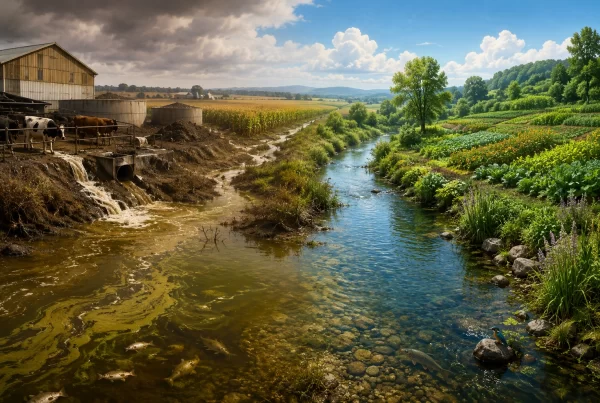
- Agricultural runoff carries substances from soil, fertilizers, animal waste, and chemicals into water systems
- Nitrogen and phosphorus are central to the problem
- The problem begins when these nutrients are not absorbed by crops
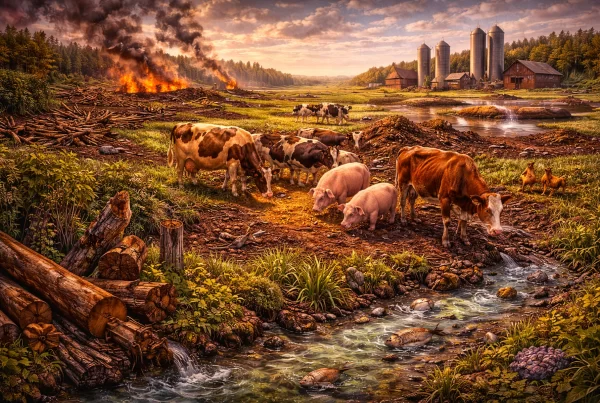
- Large livestock systems produce huge amounts of manure.
- Excess nitrogen and phosphorus feed algal blooms.
- Algal blooms can lead to a drop in oxygen in the water.
- Low oxygen creates hypoxia and “dead zones”.
- Dead zones are the end result of a chain of processes.
- The problem does not affect only the seas.
When we talk about the relationship between food and water, we usually think about how much water is needed to produce a given product. But there is another question too: what happens to rivers, lakes and seas when livestock waste, fertilizers, nitrogen and phosphorus enter water systems?
Water is not only used. It can also be polluted.
When we discuss the environmental impact of food, we often start with the water footprint — how many liters of water are needed to produce 1 kilogram of meat, milk, eggs, legumes or plant-based alternatives. This is an important topic. But it is not the whole picture.
Water is not only a resource that is used. It is also an environment that can be polluted.
A farm can use water for the animals, for cleaning, for processing products and for growing feed crops. But afterward, part of the waste from the system can return back into nature — through runoff from fields, leakage from manure storage, rainwater, polluted drains or direct access of animals to rivers and streams.
This makes the topic more complex. The question is not only:
“How much water does animal farming use?”
But also:
“What does animal farming return back into the water?”
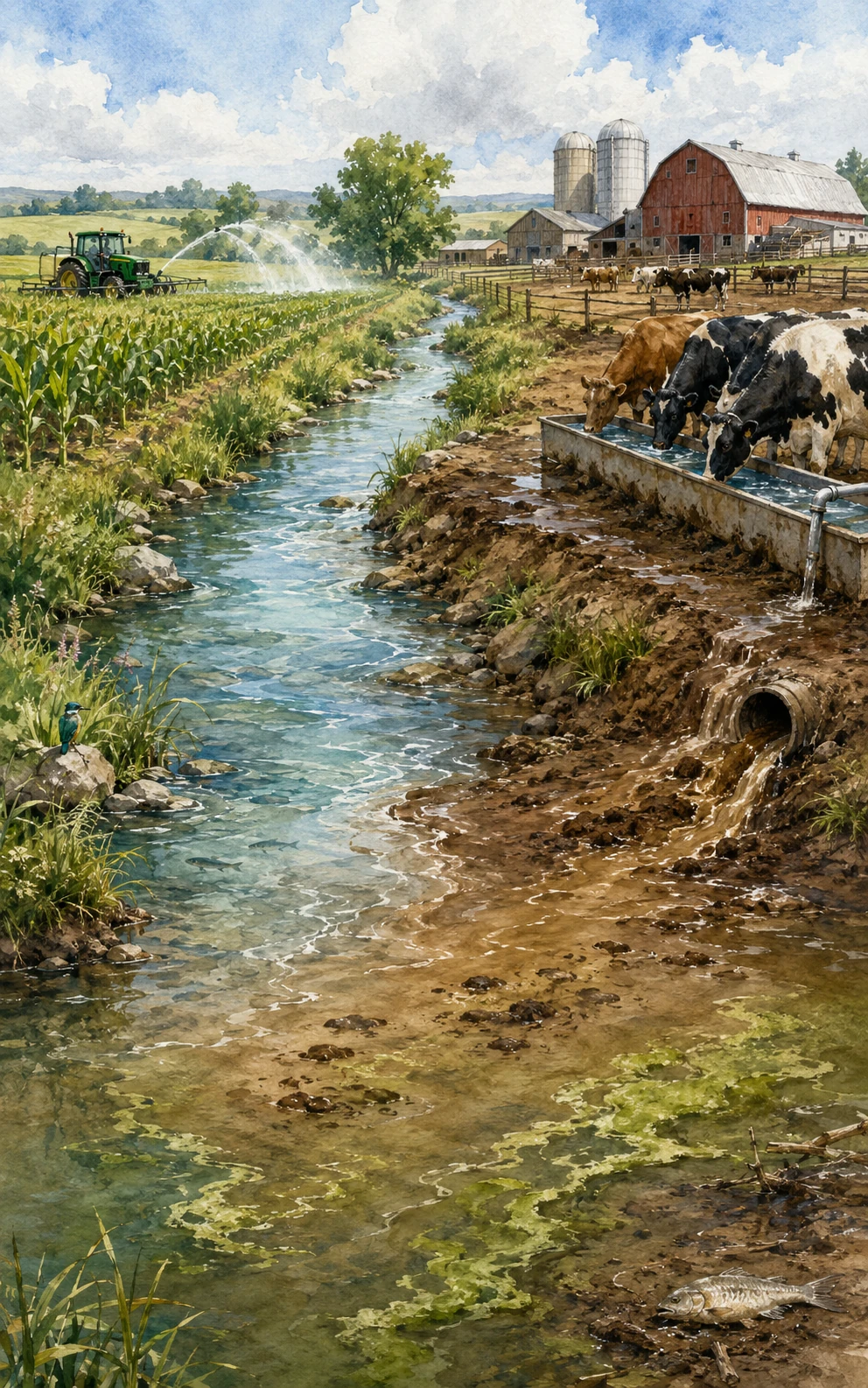
A joint FAO and IWMI review describes agriculture — including crop production, livestock farming and aquaculture — as an important source of water-quality degradation through nutrients, pesticides, salts, sediments, organic matter, pathogens and emerging pollutants such as antibiotics and hormones.
What is agricultural runoff?
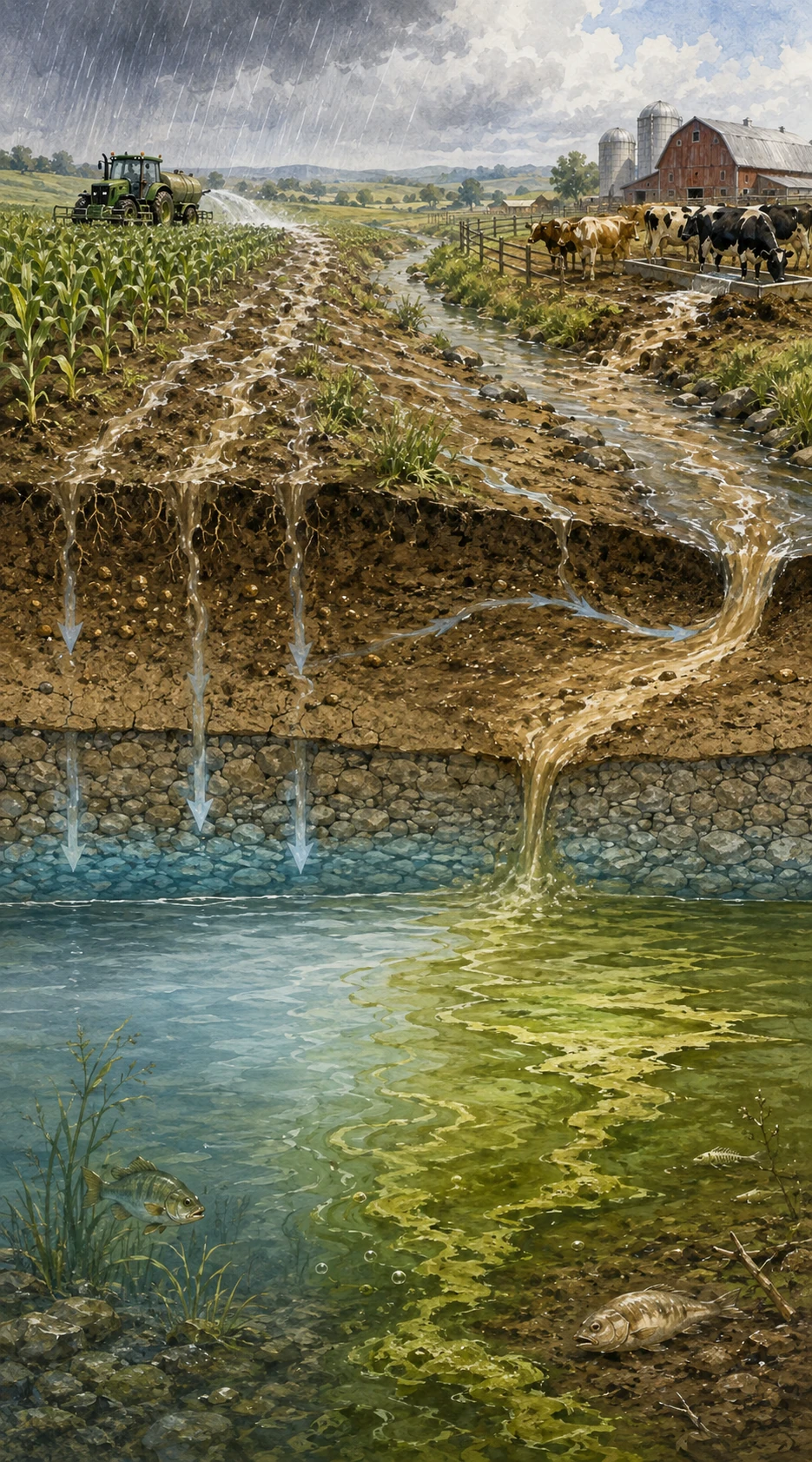
Agricultural runoff is the process in which water from rain, snowmelt or irrigation passes through agricultural land and carries away substances from the soil, fertilizers, animal waste or chemicals used in farming.
Sometimes this happens visibly — for example, when muddy water runs from a field into a nearby stream. Other times the process is slower and invisible: nitrates and other soluble substances can pass through the soil and reach groundwater.
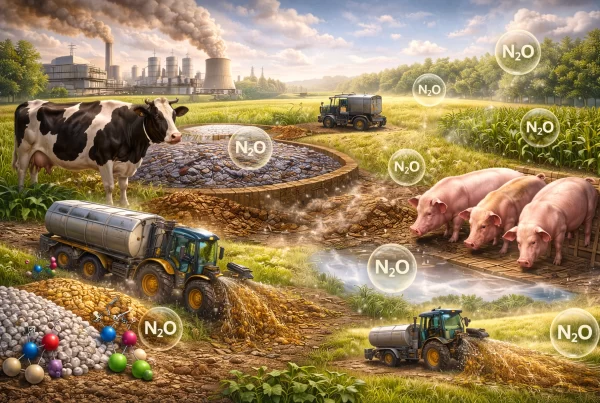
The most important substances in this topic are nitrogen and phosphorus. They are needed for plant growth. That is why they are used in mineral fertilizers and are found in animal manure. The problem begins when these nutrients are not absorbed by crops and instead enter rivers, lakes, reservoirs or seas.
EPA explains this mechanism directly: nitrogen and phosphorus from chemical fertilizers and animal manure can be washed off fields during rain and snowmelt or seep through the soil into groundwater. When they reach water bodies, they can cause eutrophication, hypoxia and so-called “dead zones”.
Manure: a resource that can become a pollutant
Manure is often perceived as something “natural”. And in a certain sense, that is true. It contains organic matter, nitrogen, phosphorus and other nutrients that can feed the soil and replace part of the mineral fertilizers.
But this is true only when the amount, timing and place of application are right.
When there are too many animals in one place, an enormous amount of manure is produced. If the nearby agricultural land cannot safely absorb these nutrients, manure stops being just a resource and starts becoming a problem.
The review by He, Pagliari and Waldrip states that in 12 major livestock-producing countries, approximately 9 × 10⁹ Mg of manure is produced each year — that is, about 9 billion tonnes. The authors emphasize that manure is rich in nutrients, but it can also become a pollutant when over-applied to cropland or when it runs off into surface waters.
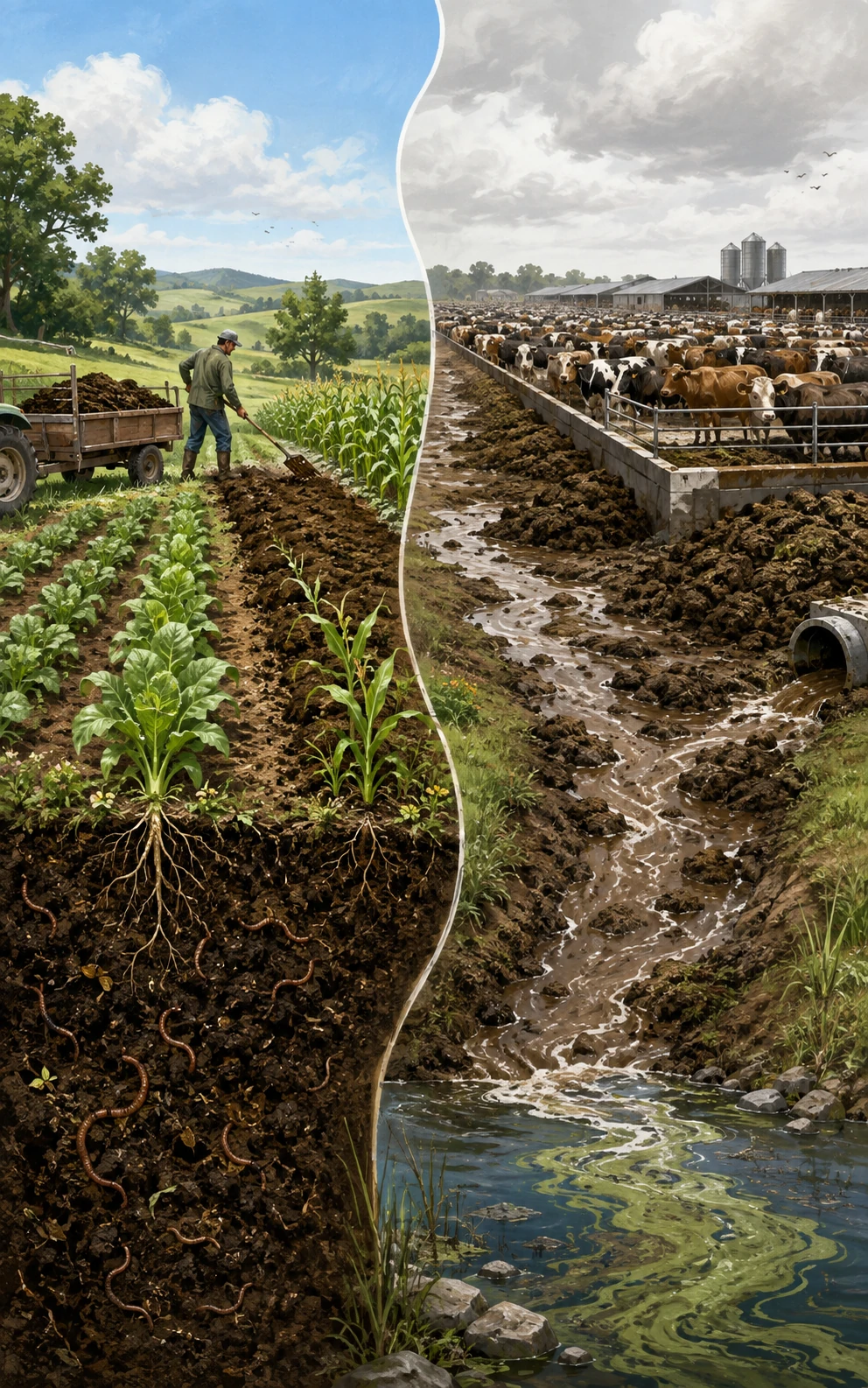
The problem is not that manure exists. The problem is when nutrients accumulate in amounts that the soil, plants and local ecosystem cannot absorb.
FAO also examines the effect of manure through the balance between nutrient inputs and outputs. If the system is balanced, a large share of the nutrients is absorbed by crops. But if there is a surplus, losses begin — through ammonia emissions, nitrate leaching, phosphorus loss and runoff into surface waters.
Nitrogen, phosphorus and algae
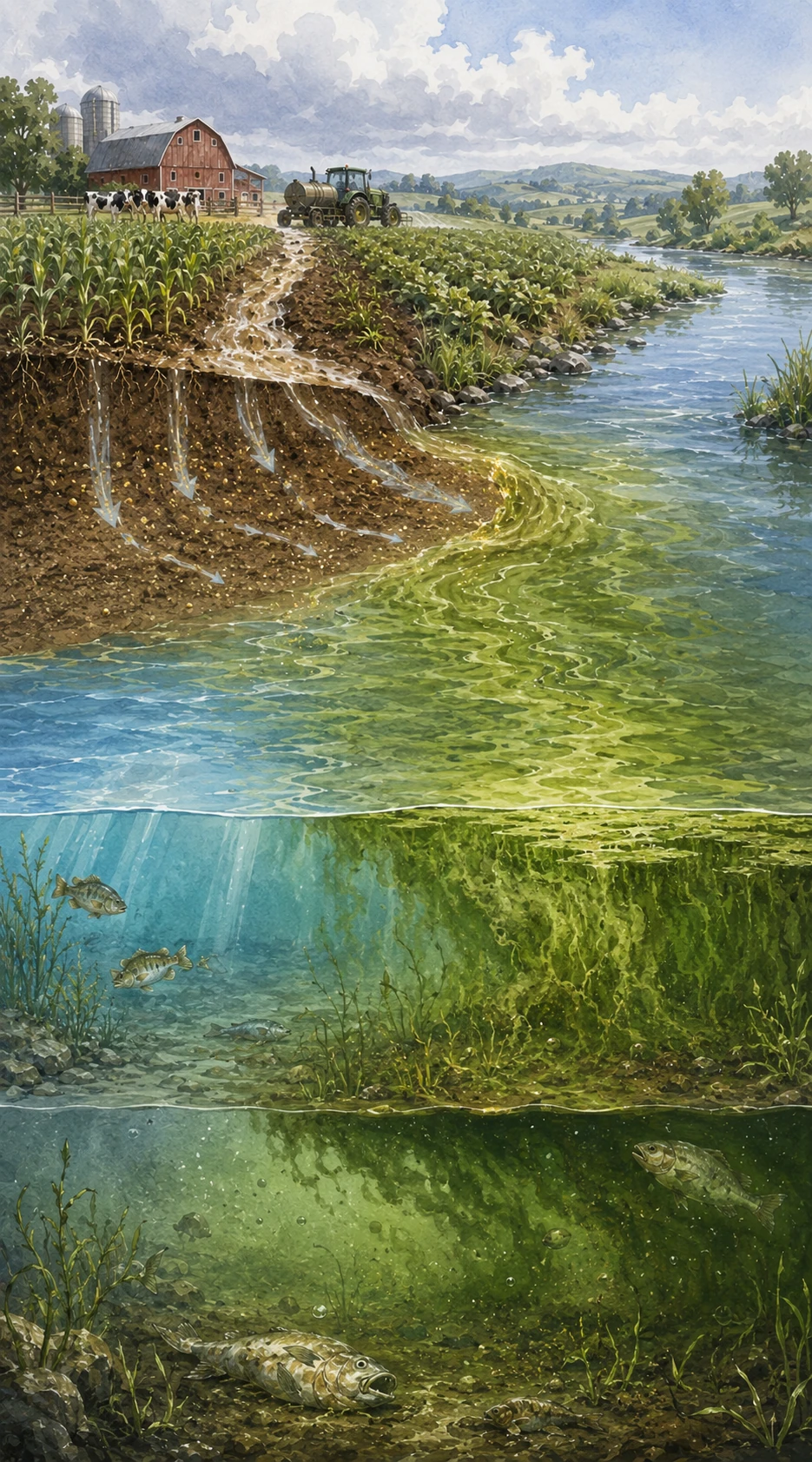
Nitrogen and phosphorus are not “toxic” by themselves. They are nutrients. Without them, plants cannot grow normally.
But that is exactly what makes them problematic in water.
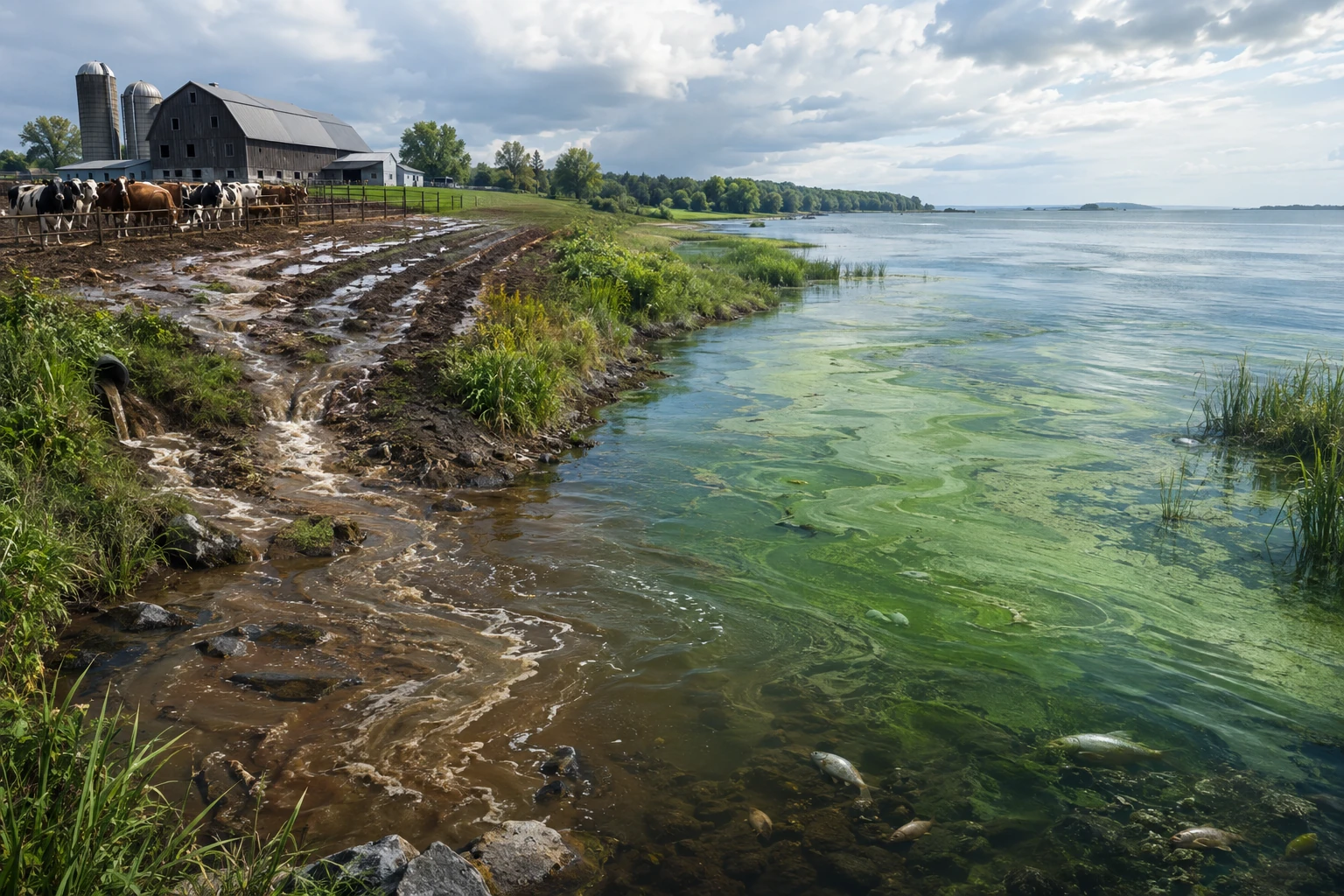
When too much nitrogen and phosphorus enter rivers, lakes or coastal waters, they begin to feed rapid algae growth. This phenomenon is called an algal bloom.
At first glance, it may look like the water is simply “turning green”. But the process has consequences:
- the algae multiply quickly;
- the water becomes cloudy;
- sunlight has more difficulty reaching underwater plants;
- when the algae die, microorganisms begin to break them down;
- this decomposition uses oxygen;
- the oxygen level in the water drops.
This way, nutrients that can be useful in the field can disrupt the entire ecosystem in the water.
EPA describes this process clearly: excess nitrogen and phosphorus lead to rapid algae growth, and when the algae die and decompose, oxygen in the water is depleted. The lack of oxygen makes survival difficult or impossible for aquatic organisms.
What are dead zones?
“Dead zone” sounds dramatic, but the term describes a very specific phenomenon: an area of a water body where dissolved oxygen levels are so low that many aquatic organisms cannot survive.
This condition is called hypoxia.
Fish can escape if they have the chance. But organisms that move slowly or are attached to the bottom — mussels, crustaceans, some invertebrates and benthic ecosystems — are much more vulnerable.
Dead zones do not appear out of nowhere. They are the final step in a chain of processes:
fertilizers and animal waste → nitrogen and phosphorus → algal blooms → decomposition → oxygen decline → loss of life in the water
One of the best-known examples is the hypoxic zone in the Gulf of Mexico, which forms every summer. NOAA describes it as mainly the result of excess nutrients from human activities in urban and agricultural areas in the Mississippi-Atchafalaya Basin. For 2026, the forecast is for the zone to reach about 7,027 square miles, more than the 39-year average measured area of 5,223 square miles.
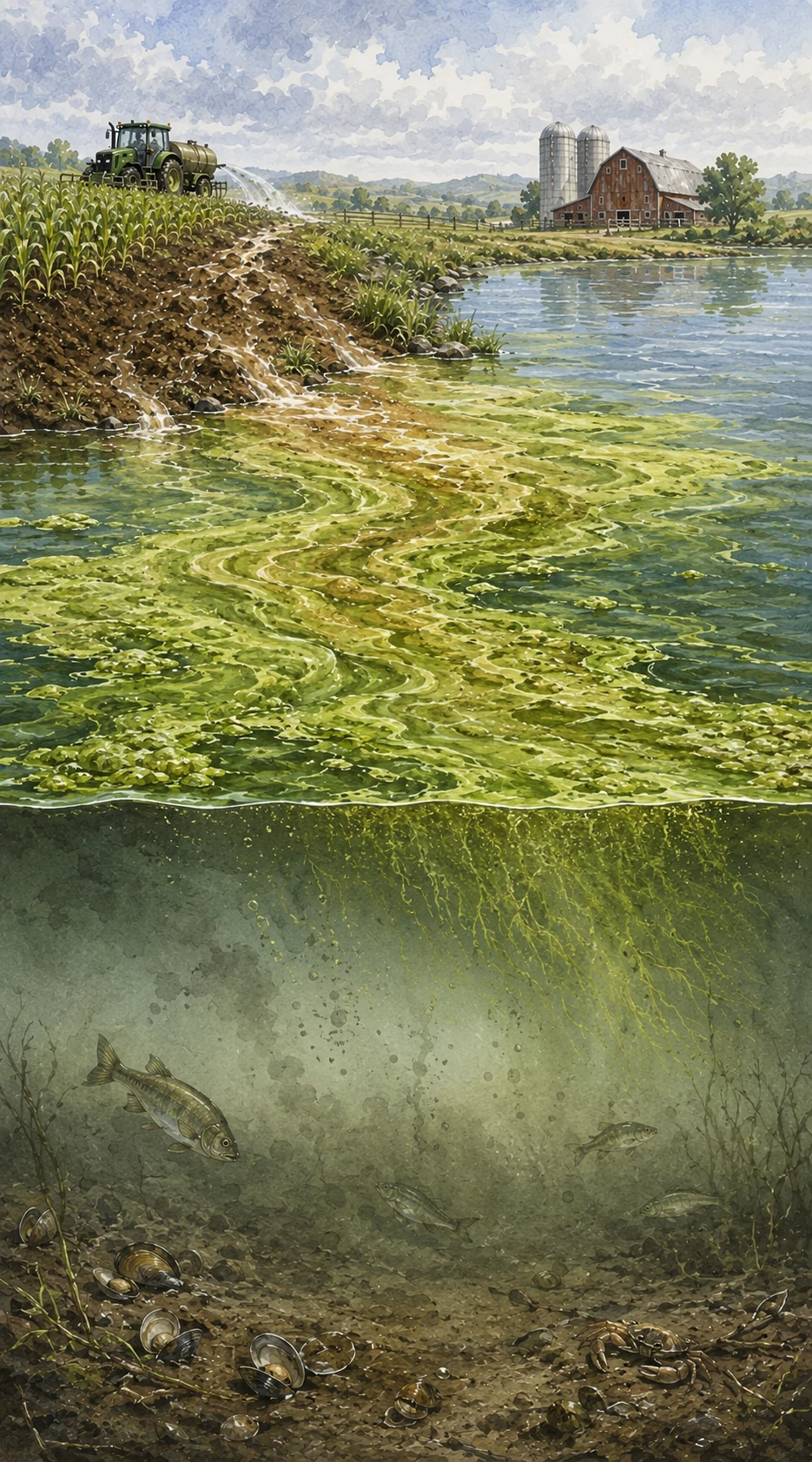
It is important to clarify: dead zones are not only a “sea problem”. Similar processes can affect lakes, reservoirs, rivers, bays and coastal waters. The difference is mainly scale.
Sources
https://www.sciencedirect.com/science/article/abs/pii/S0048969700003739
https://www.sciencedirect.com/science/article/abs/pii/S100201601560087X
https://pmc.ncbi.nlm.nih.gov/articles/PMC6395385/
https://arxiv.org/abs/2006.09122
https://oceantoday.noaa.gov/deadzonegulf/
https://oceanservice.noaa.gov/news/jun26/summer-dead-zone.html
https://www.epa.gov/nutrientpollution/sources-and-solutions-agriculture
https://www.epa.gov/nutrientpollution/effects-dead-zones-and-harmful-algal-blooms
https://www.epa.gov/npdes/animal-feeding-operations-afos