
- The price of meat also has a human dimension
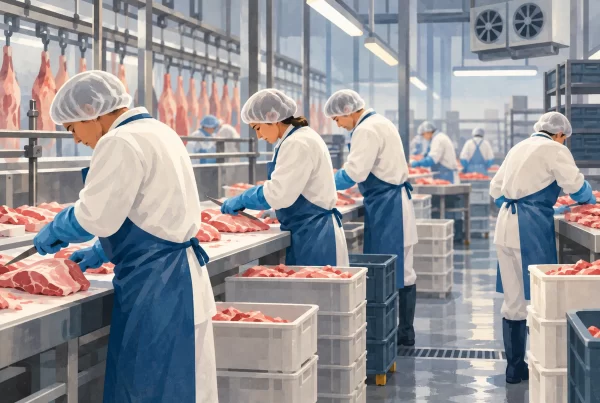
- Meat processing still relies heavily on manual labor
- The work can be physically demanding and risky
- Repetitive movements are a major problem
- Cumulative strain can affect the wrists, fingers, elbows, shoulders, neck, and back
- Production-line speed has a human cost
- Higher productivity is not necessarily more dangerous
- Safety depends on the entire system
- Migrant workers can be in a more vulnerable position
- The real question is not only how much the job pays, but whether the pay compensates for the risk and strain
The psychological side of the work
This topic is more difficult to study.
Working in a slaughterhouse involves not only physical strain, but for some employees also direct participation in killing or dismembering animals.
A systematic review of 14 studies published by Slade and Alleyne found associations between slaughterhouse work and poorer psychological well-being, as well as higher rates of depression, anxiety, and various coping mechanisms for dealing with stress.
But there is an important qualification here.
The authors themselves emphasize that the evidence base is small and methodologically limited.
It does not allow us to say conclusively:
“Working in a slaughterhouse causes these psychological problems.”
For example, it is unclear to what extent the results are influenced by:
- income;
- the social environment;
- physical strain;
- night work;
- job insecurity;
- pre-existing psychological problems;
- the act of killing animals itself.
Therefore, the more accurate conclusion is:
There are enough signals to take the issue seriously, but not enough evidence to speak of a simple cause-and-effect relationship.
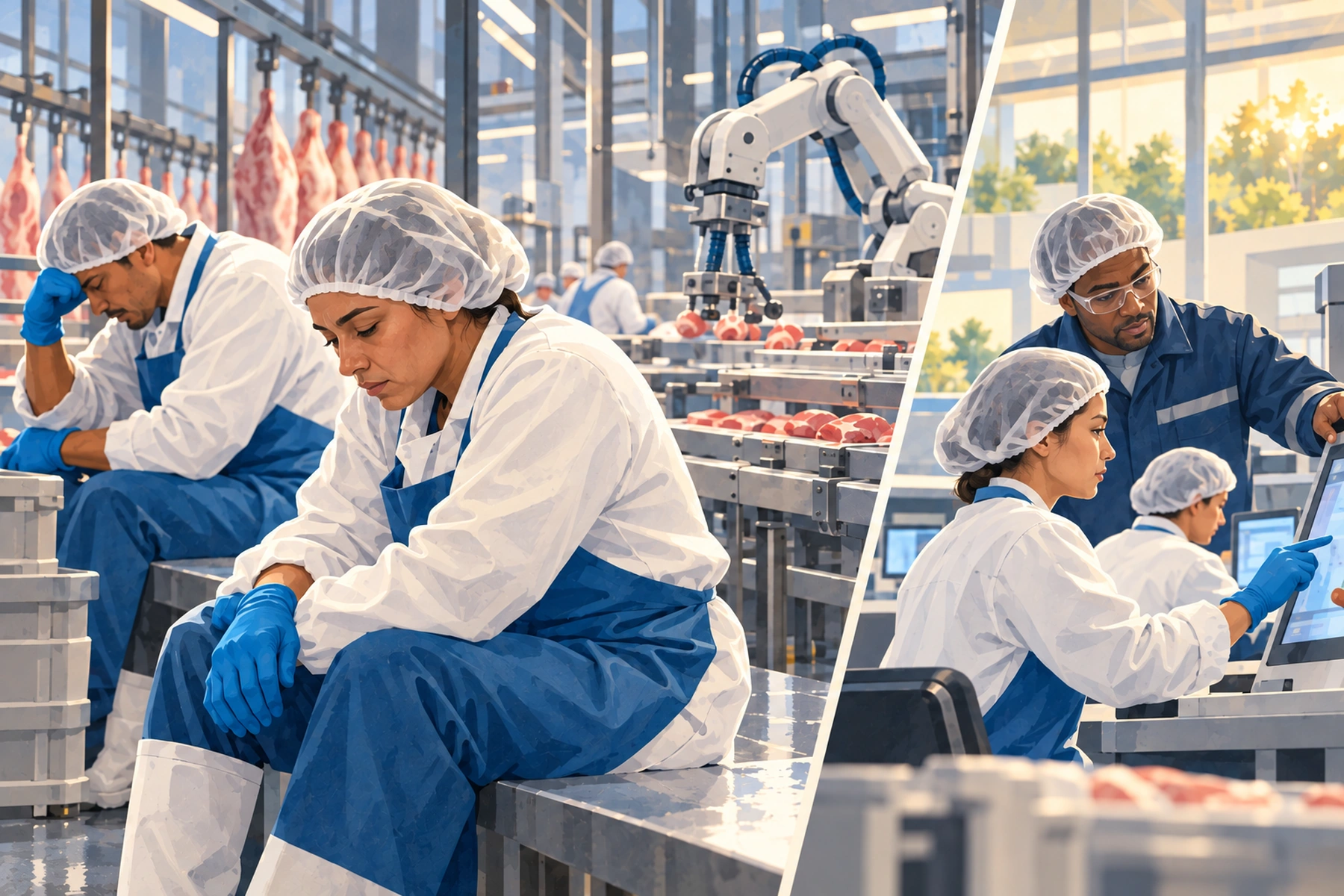
Automation can help
One obvious solution for physically dangerous tasks is automation.
Machines can take over:
- heavy lifting;
- some of the deboning;
- certain cuts;
- sorting;
- packaging;
- transporting;
- some cleaning tasks.
OSHA specifically identifies automation and mechanical devices as possible ways to reduce excessive force and repetitive movements. OSHA
At first glance, this looks like an obvious win.
- Fewer dangerous tasks.
- Fewer cuts and lacerations.
- Less physical strain.
But automation also has another side.
When the machine replaces the hardest work
If one machine can perform work that previously required ten people, that can improve the safety of the specific task.
But at the same time:
ten jobs can become one or two.
And the new positions may now require:
- technical literacy;
- operation of automated systems;
- maintenance;
- electronics;
- programming;
- quality control.
In other words, technology does not simply eliminate work.
It changes the type of work.
This is one of the central challenges in any industrial transition.
A person who has spent 15 years deboning meat does not automatically become a robotic-systems technician.
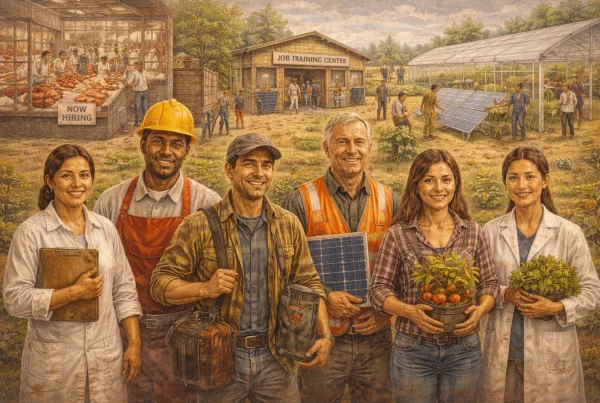
And this is where the issue of a just transition begins
If meat consumption declines in the future, automation increases, or part of production shifts toward plant-based and fermented proteins, workers in the traditional industry should not simply be left to “adapt.”
A genuine transition requires:
- reskilling;
- training;
- financial support;
- new businesses in the same regions;
- transport to new jobs;
- recognition of existing skills;
- social protection during the period between two jobs.
Otherwise, the new food system may be more efficient and more environmentally sustainable, but socially unjust.
Not every new job is necessarily better
There is another important misconception here.
If a slaughterhouse is replaced by a plant-protein factory, that does not automatically mean that workers are better off.
The new facility can also have:
- low wages;
- night shifts;
- repetitive work;
- insecure contracts;
- a fast production pace;
- limited opportunities for advancement.
That is why, during the transition to new food systems, we should not count only:
“How many jobs have been created?”
We should also ask:
What kind of jobs have been created?
What would better work look like?
We do not need to wait for the future to improve working conditions.
Even in the existing meat industry, measures can be introduced such as:
Better ergonomics
Workstations and tools should be adapted to the person, not the person to the production line.
A realistic production speed
Speed should be matched to the number of workers and to whether the task can be performed safely.
Automation of the most dangerous tasks
Heavy lifting, some cutting tasks, and highly repetitive work can gradually be taken over by machines.
Task rotation
Changing movements can reduce the strain placed on the same muscles and joints.
Sufficient breaks
Muscles and tendons also need time to recover.
Better training
Especially when working with cutting machines, knives, chemicals, and refrigeration systems.
Protection for migrant workers
Information about labor rights should be available in a language workers understand.
Stronger oversight
Labor inspections and independent monitoring are especially important where workers are in a weak bargaining position.
Cheap meat does not begin at the store
The consumer sees the final price.
For example:
10 euros.
15 euros.
20 euros.
But that price is the result of an entire system.
It includes:
- land;
- feed;
- animals;
- energy;
- water;
- transport;
- equipment;
- refrigeration systems;
- workers;
- logistics;
- retail and trade.
And if the system has to produce more and more at the lowest possible price, pressure to reduce costs runs through all of these elements.
Including labor.
This does not mean that low meat prices are necessarily caused by poor working conditions.
But it does mean that labor should not remain invisible when we talk about the efficiency of the system.
Conclusion: the food system is made up of people too
The discussion about industrial livestock farming usually focuses on several areas.
- Animals.
- Climate.
- Land.
- Water.
- Health.
But there is another group that rarely appears in the conversation:
the people who do the work.
The people who stand on the production lines.
The people who cut, debone, clean, and package.
The people who work in cold facilities and repeat the same movements hundreds or thousands of times per shift.
The people who are sometimes migrants, temporary workers, or people with limited employment alternatives.
That is why the conversation about the future of food should not be:
“How do we eliminate these jobs?”
A better question is:
“How do we create a food system in which people do not have to choose between work and health?”
That may mean better conditions in the existing industry.
It may mean automating the most dangerous tasks.
It may mean new occupations.
It may mean reskilling.
And it will probably mean a combination of all of these.
Because a more sustainable food system is not truly better if the only thing we have changed is the product.
The work behind it must improve as well.
Sources:
https://www.ela.europa.eu/sites/default/files/2023-12/counteracting-undeclared-work-labour-exploitation-third-country-national-workers.pdf
https://www.bls.gov/ooh/production/butchers-and-meat-cutters.htm
https://www.osha.gov/Publications/OSHA3123/
https://www.osha.gov/meatpacking
https://www.bls.gov/oes/2023/may/oes513023.htm
https://pmc.ncbi.nlm.nih.gov/articles/PMC10009492/
https://www.bls.gov/news.release/ocwage.t01.htm
https://www.osha.gov/meatpacking
https://archive.cdc.gov/www_cdc_gov/niosh/updates/upd-03-27-14_b.html
https://www.osha.gov/news/newsreleases/osha-statement/20250113