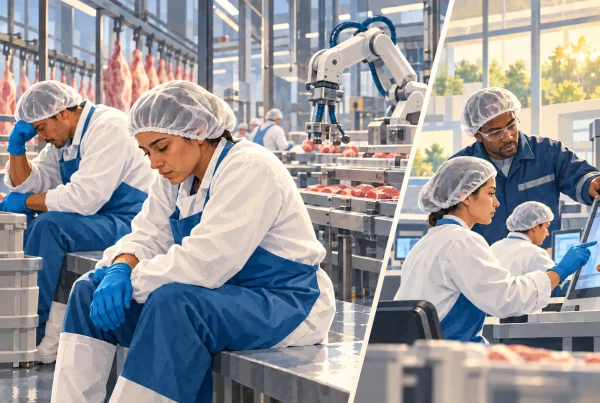

- The price of meat also includes human labor
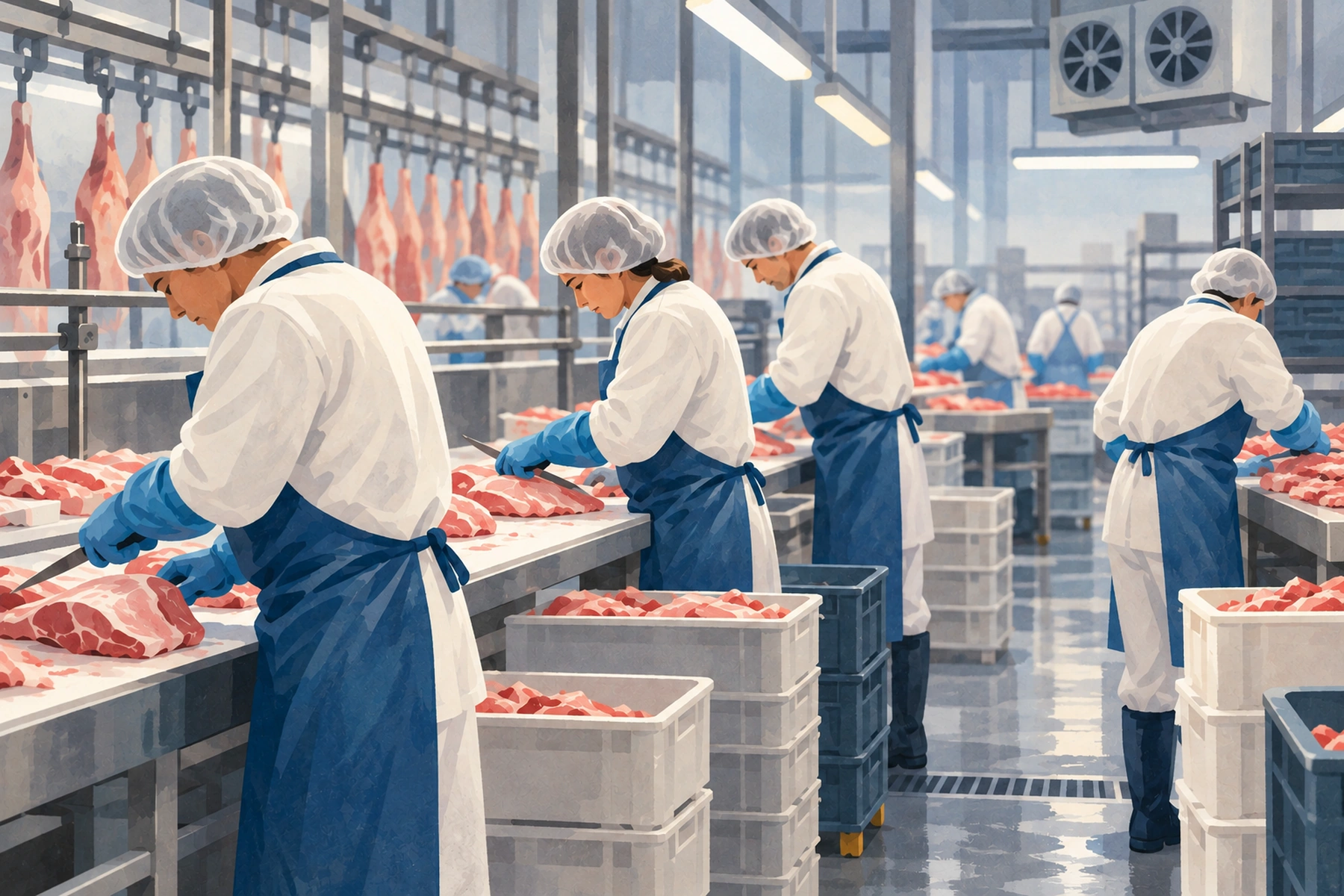
- Slaughter and meat processing still rely heavily on manual labor
- The work is often physically demanding and highly repetitive
- Repeating the same movements thousands of times
- Musculoskeletal injuries are an important occupational risk
- The working environment can involve various hazards
- Production-line speed matters
- Higher productivity is not necessarily more dangerous
- Safety depends on how the entire production system is organized
- Migrant labor plays an important role in parts of the European meat-processing industry
- Limited job options, language barriers, and dependence on intermediaries and employers
- The question is not only how much the job pays, but whether the pay compensates for the risk and strain
When we talk about the price of meat, we usually think about how much it costs in the store. We think less often about the labor behind that price.
Slaughtering, cutting, deboning, cleaning, chilling, and packaging still require a significant amount of human labor. Some of these jobs are physically demanding, highly repetitive, and involve sharp tools, cold temperatures, noise, dangerous machinery, and a fast production pace.
This does not mean that every worker in the meat industry works under poor conditions. Nor does it mean that the problem can be reduced to “bad employers.”
The more important question is structural:
What does work look like in a food system that has to process huge quantities of meat quickly and at low cost?
Meat also has a labor footprint
When we evaluate a food, we often talk about its carbon footprint, the land it uses, its water use, or its impact on biodiversity.
But there is another indicator that is difficult to capture in a single number:
the human labor behind the product.
Before meat reaches the store, restaurant, or home kitchen, many people are involved along the production chain.
Someone has to:
- transport the animals;
- handle them when they arrive;
- carry out the slaughter;
- process the carcasses;
- cut the meat;
- debone it;
- trim and clean the meat;
- package it;
- maintain the refrigeration systems;
- clean the production lines;
- perform quality control;
- move the finished products.
Highly automated facilities can reduce the need for manual labor at some stages, but much of meat processing still relies on people performing fast, precise, and repeatedly recurring movements.
Why is meat processing physically demanding work?
The U.S. Occupational Safety and Health Administration — OSHA — describes meat processing as a sector with a number of serious safety and health risks.
These include:
- high noise levels;
- dangerous production equipment;
- slippery floors;
- musculoskeletal injuries;
- chemical hazards, including ammonia from refrigeration systems;
- biological hazards from contact with animals, blood, and fecal material.
This combination matters.
The worker is not simply performing physical labor.
They may be performing physical work quickly, repeatedly, in a cold environment, with a knife or machine, and close to other workers carrying out the same process.
Thousands of identical movements
One of the most characteristic problems in industrial meat processing is repetition.
- Cutting.
- Trimming.
- Separating.
- Deboning.
- Moving.
- Packaging.
- Then the same movement again.
- And again.
- And again.
OSHA has long identified repetitive movements, forceful exertion, awkward body positions, line speed, and insufficient recovery periods as important ergonomic risk factors in meat processing.
This can strain:
- the wrists;
- the fingers;
- the elbows;
- the shoulders;
- the neck;
- the back.
The problem is not necessarily one forceful movement.
Sometimes the problem is a small strain repeated thousands of times.
Line speed matters
In industrial production, time is an economic factor.
The more product that passes through the production line in an hour, the greater the facility’s capacity can be.
But speed also has a human side.
In 2025, the U.S. Department of Labor commented on findings from a USDA study in pork and poultry plants. According to the department, chronic pain and musculoskeletal disorders were too common, and higher line speeds could increase the risk of injury unless offset by additional staffing and effective ergonomic measures.
This is an important detail.
Not every increase in productivity necessarily means more dangerous work.
If there are:
- more staff;
- better equipment;
- automation;
- sufficient breaks;
- good organization;
- ergonomic workstations,
higher productivity can be managed.
But if production speeds up without anything else changing, the strain on workers can increase.
Cold, knives, machines, and wet floors
Meat must be kept at low temperatures.
Production areas are often cold, wet, and noisy.
At the same time, they use:
- knives;
- saws;
- cutting machines;
- conveyors;
- lifting equipment;
- refrigeration systems.
OSHA specifically identifies dangerous equipment, slippery surfaces, noise, and chemical hazards as characteristic risks in the sector.
That is why safety does not depend only on whether the worker is careful.
It depends on the design of the entire system:
the machines, the speed, the workspace, protective equipment, training, breaks, and the number of people on the line.
Who does this work?
Here the issue becomes not only industrial, but social as well.
Many of the most demanding jobs in the food system are not especially attractive to workers who have a wide range of other employment options.
The European Labour Authority identifies slaughterhouses and meat-processing plants among the sectors employing many migrants from third countries and receiving attention from labor inspectorates in checks for undeclared work and labor exploitation. European Labour Authority
This does not mean that every migrant worker in the meat industry is exploited.
But it shows why the issue matters.
A worker who:
- does not speak the local language well;
- does not know the labor laws;
- depends on the employer for housing or documents;
- works through an intermediary;
- has limited alternative employment options,
may be in a weaker position when negotiating working conditions.
In this way, the low price of food can sometimes intersect with another economic factor:
cheap and easily replaceable labor.
And what about pay?
Here we need to be careful, because wages vary greatly between countries, regions, and companies.
So it would be misleading to simply say:
“Slaughterhouse workers are poorly paid.”
But we can look at specific data.
According to the U.S. Bureau of Labor Statistics, the median annual wage for meat, poultry, and fish processing workers in May 2025 was about $39,190.
For all occupations in the U.S. economy, the median was $50,980. Bureau of Labor Statistics
For slaughterers and meat packers specifically, the mean annual wage over the same period was about $41,770. Bureau of Labor Statistics
These are U.S. data and should not be automatically applied to Europe or Bulgaria.
But they illustrate an important principle:
in at least one large developed market, physically demanding work in meat processing is not paid above the economy-wide average — quite the opposite.
Risk versus reward
This leads to a more interesting question than the wage itself:
Does the pay compensate for the risk and strain?
A physically demanding job can be entirely acceptable if:
- it is well paid;
- it is safe;
- working hours are reasonable;
- there are sufficient breaks;
- there is occupational health monitoring;
- there are opportunities for advancement;
- the worker can freely leave and find another job.
The problem arises when several unfavorable factors come together in one place:
physically demanding work + high speed + low autonomy + limited alternatives + relatively low pay.
At that point, we are no longer simply talking about a “difficult job.”
We are talking about the quality of the job itself.
Sources:
https://www.ela.europa.eu/sites/default/files/2023-12/counteracting-undeclared-work-labour-exploitation-third-country-national-workers.pdf
https://www.bls.gov/ooh/production/butchers-and-meat-cutters.htm
https://www.osha.gov/Publications/OSHA3123/
https://www.osha.gov/meatpacking
https://www.bls.gov/oes/2023/may/oes513023.htm
https://pmc.ncbi.nlm.nih.gov/articles/PMC10009492/
https://www.bls.gov/news.release/ocwage.t01.htm
https://www.osha.gov/meatpacking
https://archive.cdc.gov/www_cdc_gov/niosh/updates/upd-03-27-14_b.html
https://www.osha.gov/news/newsreleases/osha-statement/20250113