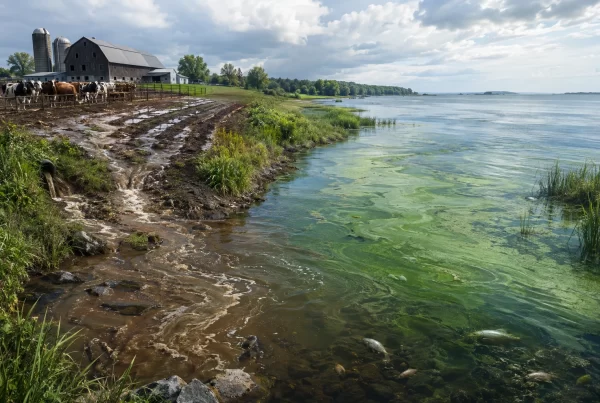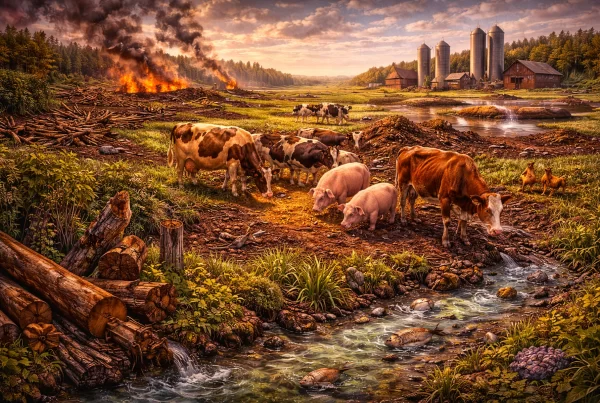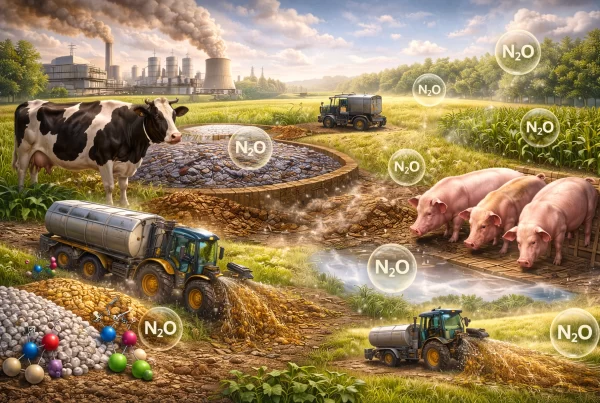

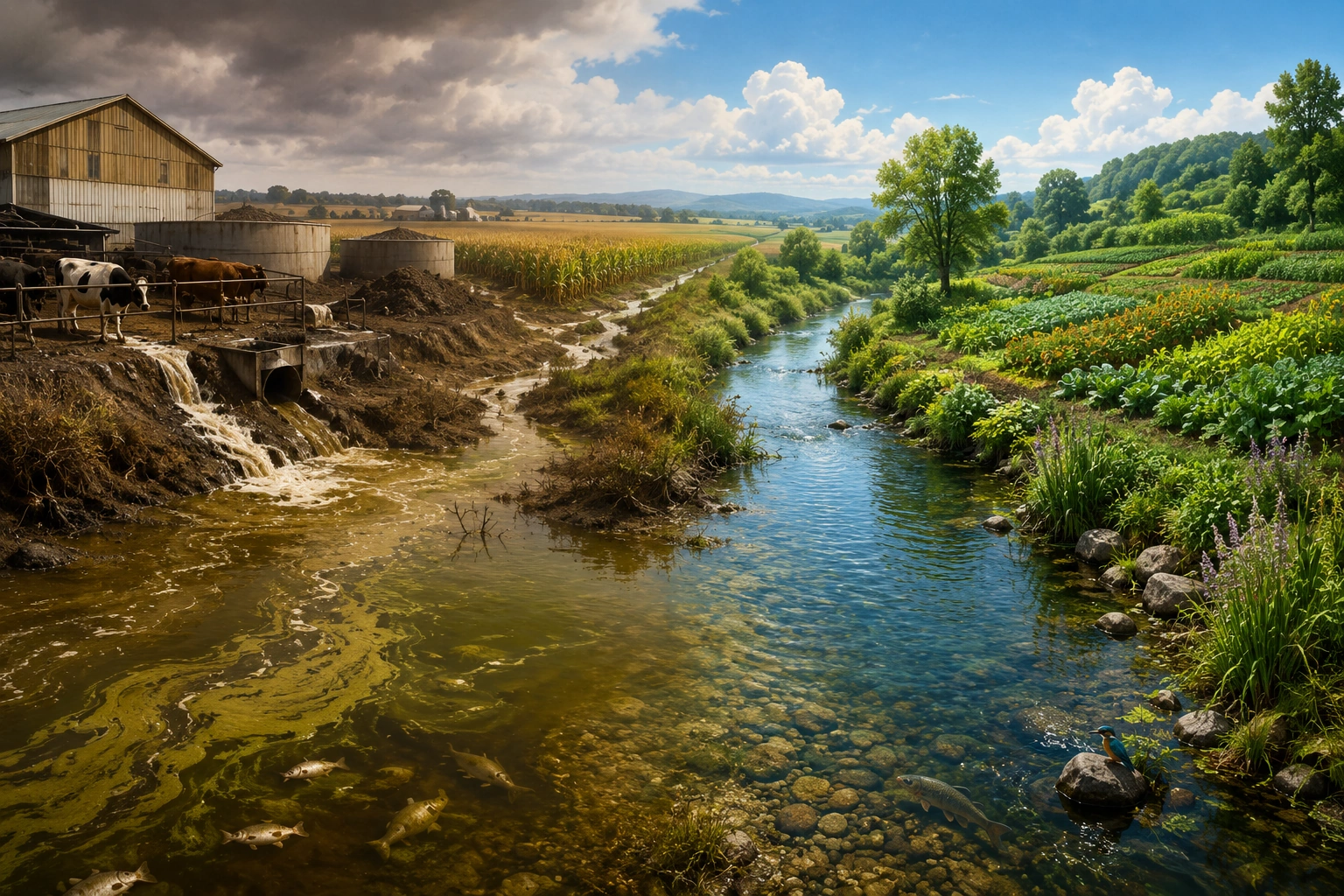
- Livestock farming pollutes water in two ways — directly and indirectly.
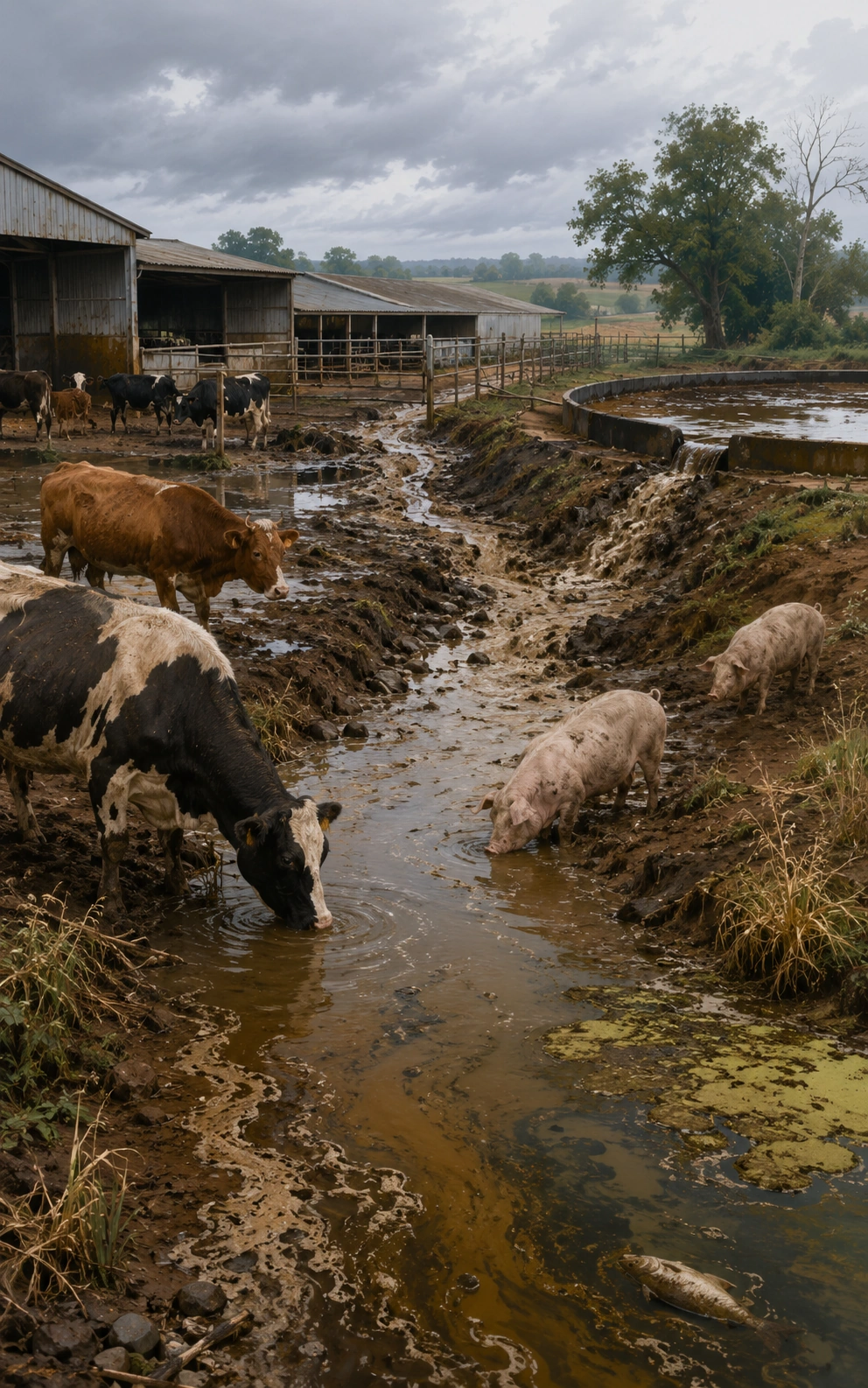
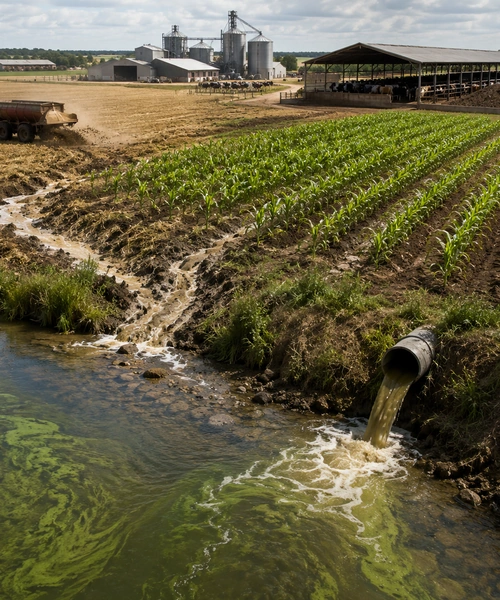
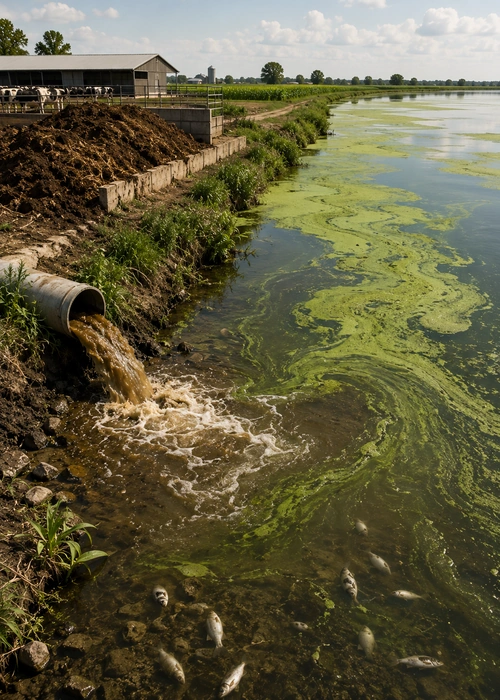
- Direct pollution comes from manure, urine, wastewater, and runoff from barns, yards, feeding areas, and manure storage sites.
- When animals have access to rivers and streams, the risk of pollution increases
- Manure can be a useful resource, but only when it is managed well.
- Organic matter from animal waste can deplete oxygen in water because, as it decomposes, microorganisms use the dissolved oxygen.
- The indirect effect comes from feed crops.
- Livestock farming is not only “animals on a farm”, but an entire production system
- Plant-based foods are not impact-free
- When we eat plants directly, we usually skip the inefficient intermediate step of the “animal”
- More direct consumption of plant-based foods can reduce pressure on land, water, and ecosystems
- Solutions need to be systemic, not only technical
- Less industrial livestock farming can mean cleaner rivers, lakes, and seas
In the previous article, we looked at dead zones and the conditions that lead to their formation and existence. In this article, we will show you how livestock farming helps create those conditions.
How livestock farming contributes directly and indirectly
Livestock farming can pollute water in two main ways: directly and indirectly.
Direct pollution
It comes from the animals themselves and from the waste around them.
Examples:
- animals that have free access to streams and rivers;
- urine and feces near water bodies;
- runoff from barns, yards, and feeding areas;
- leakage from lagoons or manure storage sites;
- polluted wash water;
- silage effluent and other organic waste.
FAO notes that the direct discharge of manure into water can lead to anaerobic conditions, because easily degradable organic matter begins to decompose and uses dissolved oxygen, which can kill aquatic flora and fauna. The same source notes that runoff from places with concentrated animals — such as barns, feeding areas, and yards — can reach surface waters directly or indirectly.
Indirect pollution
It comes from feed crops.
Animals do not eat only grass. In industrial livestock farming, huge areas are used to produce feed — corn, soy, grains, and other crops. These fields are also fertilized. Some of the nitrogen and phosphorus from these systems can be washed away or leach into water.
Livestock farming therefore does not affect water only through the waste of the animals themselves. It also affects water through the agriculture that supports livestock farming.
This is an important point because we often see only the final food: meat, milk, cheese, eggs. But behind them stands an entire production system: feed, land, fertilization, transport, animals, waste, manure storage, and processing.
Why plant-based foods usually create less pressure
Plant-based eating does not have “zero impact”. Plants are also grown on land. They too can involve irrigation, fertilization, erosion, pesticides, and runoff.
But there is one major difference.
When we eat plants directly, we usually skip the intermediate step of the “animal”. We do not first need to grow large amounts of feed, then feed an animal, then manage the manure from that animal, and only then obtain meat or milk.
That is why, in many cases, plant-based foods create less pressure on land, water, and ecosystems. The large analysis by Poore and Nemecek, published in Science, compares different foods and production systems and concludes that even the lowest-impact animal products often have a higher impact than their plant-based alternatives.
In the context of water pollution, this means something practical:
- fewer animals in industrial systems;
- less concentrated manure;
- less need for feed crops;
- fewer excess nutrients;
- a lower risk of nitrogen and phosphorus pressure on water systems.
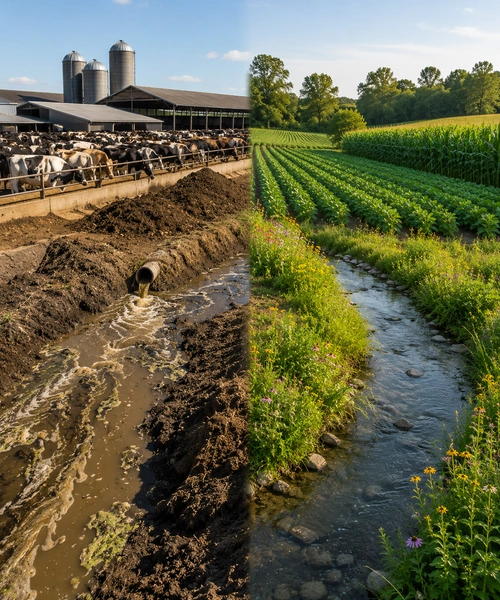
This does not mean that every plant-based food is automatically perfect. The way it is produced matters. But as a general direction, shifting toward more direct consumption of plant-based foods reduces part of the systemic pressure that is characteristic of livestock farming.
What can reduce the problem?
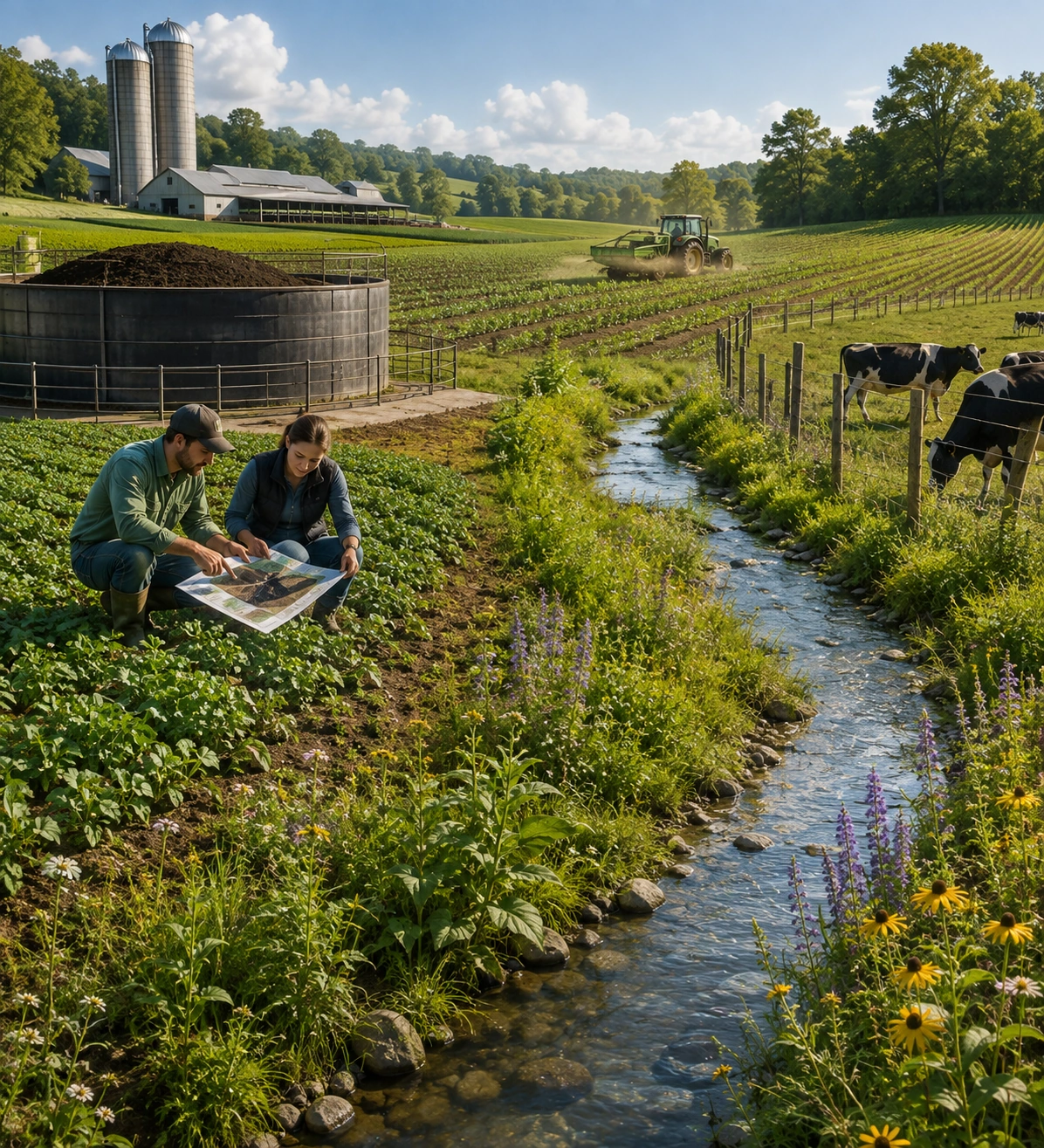
There is no single solution. Water pollution from agriculture and livestock farming is a systemic problem, so the solutions also need to work on several levels.
At farm level, the following can help:
- more precise calculation of nitrogen and phosphorus needs;
- using manure according to crop needs, rather than as a way to dispose of waste;
- avoiding fertilization before heavy rain;
- avoiding fertilization on frozen, waterlogged, or steeply sloped soil;
- better manure storage;
- vegetated buffer strips around rivers and streams;
- limiting animal access to waterways;
- cover crops and better soil management.
EPA points to a range of similar practices: applying nutrients in the right amount, at the right time, and with the right method; using cover crops; buffer strips; conservation tillage; and managing animal access to water bodies.
But there is also a broader level.
If a given system has too many animals and too little land that can realistically absorb the nutrients from manure, better management helps, but it does not fully solve the problem. Then the question becomes structural:
How many animals can an agricultural system support without turning rivers and soils into places for dumping excesses?
A more sustainable food system should also include reducing the industrial concentration of animals, using more plant-based sources of protein, better management of feed crops, and less food loss.
Conclusion: less livestock farming can mean cleaner waters
When we talk about livestock farming and water, we should not look only at the liters needed to produce meat or milk.
We also need to look at water quality.
Because water can be used. But it can also be polluted.
Manure can be a useful resource when it is part of a balanced agricultural system. But in excessive quantities, in the wrong place, or at the wrong time, it becomes a source of nitrogen, phosphorus, organic matter, and pathogens that can reach rivers, lakes, groundwater, and seas.
From there, the process is familiar:
- more nutrients;
- more algae;
- less oxygen;
- less life in the water.
That is why dead zones are not just a distant environmental problem. They are a symptom of a food system in which too many resources enter one place, and too much waste leaves another.
Cleaner rivers, lakes, and seas do not depend only on wastewater treatment plants and bans. They also depend on the way we produce our food.
Less industrial livestock farming, more direct consumption of plant-based foods, better land management, and fewer excesses can reduce pressure on aquatic ecosystems.
Not because plant-based agriculture has no impact.
But because any system that produces less excess manure, uses less feed, and returns less nitrogen and phosphorus to water gives rivers, lakes, and seas a better chance of staying alive.
Sources
https://www.sciencedirect.com/science/article/abs/pii/S0048969700003739
https://www.sciencedirect.com/science/article/abs/pii/S100201601560087X
https://pmc.ncbi.nlm.nih.gov/articles/PMC6395385/
https://arxiv.org/abs/2006.09122
https://oceantoday.noaa.gov/deadzonegulf/
https://oceanservice.noaa.gov/news/jun26/summer-dead-zone.html
https://www.epa.gov/nutrientpollution/sources-and-solutions-agriculture
https://www.epa.gov/nutrientpollution/effects-dead-zones-and-harmful-algal-blooms
https://www.epa.gov/npdes/animal-feeding-operations-afos