
- Freed land can serve several possible functions
- Not every type of land is suitable for everything
- Food, climate and nature require balance
- Spatial planning is decisive
- Prioritizing food gives more yield
- Prioritizing climate gives more carbon capture
- Bioenergy involves real trade-offs
- The balanced model brings the most benefits
- Random allocation wastes potential
- Freed land requires an active strategy
- State policy is key
- The protein transition also requires a land-use transition
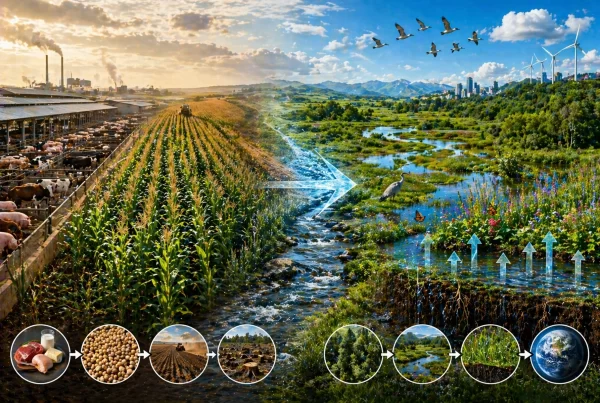
After we told you in the previous article how much land could be “saved”, or at least used more beneficially for the common good of the planet, in this article our task will be to show you in more detail the different ways this can happen according to human needs, the possibilities of the land, and the nature of the climate.
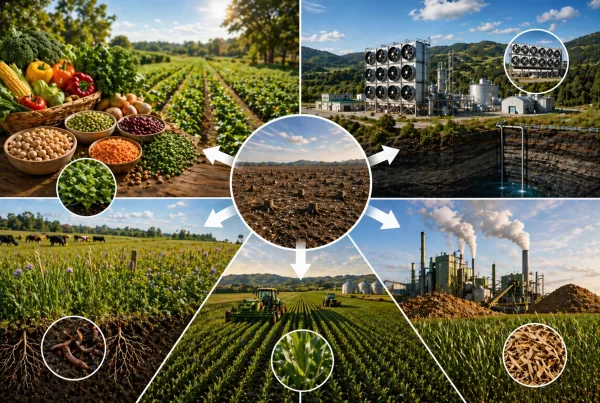
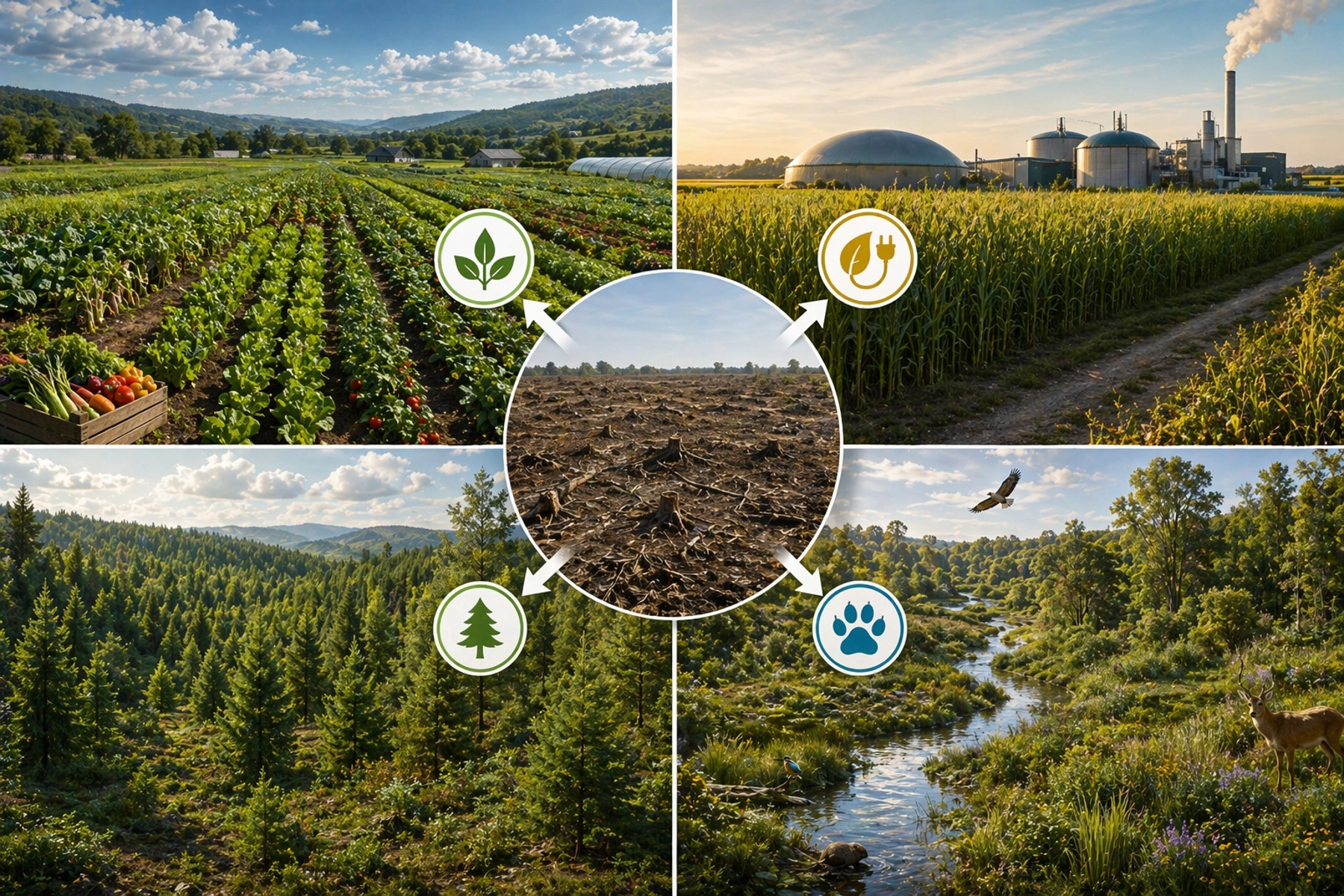
When a territory that has already been deforested is “freed”, or in other words when crops stop being grown there for livestock feed, it can be used in four main directions:
- Food production for people (recultivation)
- Bioenergy (energy crops, BECCS)
- Afforestation (for absorbing carbon emissions from the air)
- Rewilding (for restoring biodiversity)
Unfortunately or not, we cannot maximize all four at the same time on the same piece of land. This is where trade-offs and optimization come in. What is very important to know is:
- Not all freed land is the same in terms of soil, climate, location, or food potential.
- Some land is better suited for carbon absorption and biodiversity (humid tropics, degraded pastures near forests).
- Some may be most suitable for bioenergy (near energy infrastructure, lower biodiversity value).
Because of this, prioritization becomes essential.
Four broad global strategies for freed land
Let us define four general strategies for allocating this potential “freed land fund” of ~750 Mha:
- Food priority
- Climate priority
- Bioenergy priority
- Balanced optimization (food + climate + nature)
The numbers below are illustrative only, to show the order of magnitude of possible changes.
Strategy 1 – Food production comes first
Goal: maximize additional food production.
Approximate allocation:
- 70% for recultivation for food
- 20% for mixed afforestation/rewilding
- 10% for bioenergy crops
Potential results (rough scaling):
Food: potentially enough additional calories to feed over one billion people, depending on productivity and diet.
Climate:
- Large indirect benefit from the dietary shift itself (−31% reduction in agricultural emissions).
- Modest increase in carbon absorption from limited afforestation.
Risk: if care is not taken, recultivation may lead to some nitrogen and water problems (fertilizers, irrigation).
Useful for:
- Food security, especially in low-income regions.
- Reducing dependence on risky yield gains.
With very little benefit for:
- Long-term biodiversity and maximum carbon capture.
Strategy 2 – The main focus is climate impact
Goal: maximize carbon capture and ecosystem restoration.
Approximate allocation:
- 70% for natural forest recovery / rewilding forests
- 20% for mixed agroforestry / silvopasture
- 10% for food production
Potential results:
Effect on carbon emissions:
- Freely regenerating forests across hundreds of millions of hectares could remove 1–3 gigatons of CO₂ per year, depending on the region, especially during the first decades.
- Combined with the potential 31% reduction in agricultural carbon emissions, this is a huge contribution to keeping temperature rise within 1.5–2 °C.
Biodiversity:
- Habitat connectivity improves.
- Deforestation pressure could almost disappear in many regions.
Food:
- Minor additional production – it relies on the dietary shift itself and yield improvements elsewhere to guarantee food security.
Suitable for:
- Climate targets
- Biodiversity, especially in tropical and forested regions
Risk:
- If not combined with forward-looking food-system planning and equity
in terms of local food availability or land rights.
Strategy 3 – Focus on bioenergy
Goal: grow energy crops for biofuels and carbon capture and storage.
Approximate allocation:
- 50–60% for bioenergy crops
- 20–30% for afforestation/rewilding
- The remainder for food recultivation
Potential results:
Climate:
- Indirect: dietary change still reduces agricultural emissions.
- Direct: bioenergy can displace fossil fuels; with carbon capture, it can create “negative emissions”.
Trade-offs:
- Large monoculture bioenergy plantations can harm biodiversity, soil and water.
- Social conflict over land (food versus fuel) is a real risk.
Useful for:
- The energy transition, especially if combined with carbon capture systems and good governance.
Risky for:
- Local ecosystems, if poorly managed.
- Food security and social justice, if land grabbing occurs.
Most experts currently consider large, unlimited expansion of land use for bioenergy too risky on its own; it should be only part of a carefully balanced portfolio.
Strategy 4 – Balanced optimization (food + climate + nature)
Goal: use spatial prioritization to match land with its best use and maximize combined benefits.
Rough idea:
- The best soils, close to existing infrastructure, should be used for food production.
- Regions with high carbon content and high biodiversity potential (e.g. degraded land in/near the tropics) should be allocated for afforestation / rewilding.
- Areas with lower biodiversity value and strategic locations should be used for some bioenergy, especially if it displaces coal/oil.
The key is not fixed percentages, but spatial targeting.
To compare the four strategies, we present the following table:
Стратегия | Потенциал за допълнителна храна | Потенциал за намаляване на CO2 емисии | Подобряване на биоразнообразието | Рискове |
Приоритет - храна | Много висок | Нисък - среден | Среден | Азот, вода, известен загубен климатичен потенциал |
Приоритет - климат | Нисък | Много висок | Много висок | Проблеми със сигурността на храните и равенството, свързани с лошо управление |
Приоритет - биоенергия | Среден | Среден - висок | Нисък - среден | Висок социален и екологичен риск при лошо управление |
Балансирана стратегия | Висок | Висок | Висок | Изисква силно планиране и институции |
Why spatial prioritization is absolutely necessary
Two key points:
If we simply choose land at random for afforestation or recultivation, we leave a lot of potential unused.
If instead:
- We plant food crops on the most productive soils.
- We place forest restoration where carbon capture potential is highest.
- We avoid turning naturally valuable grasslands into unsuitable forests.
…we may get:
- Up to approximately 59% more food from the same area.
- Up to approximately 43% more carbon capture from the same area.
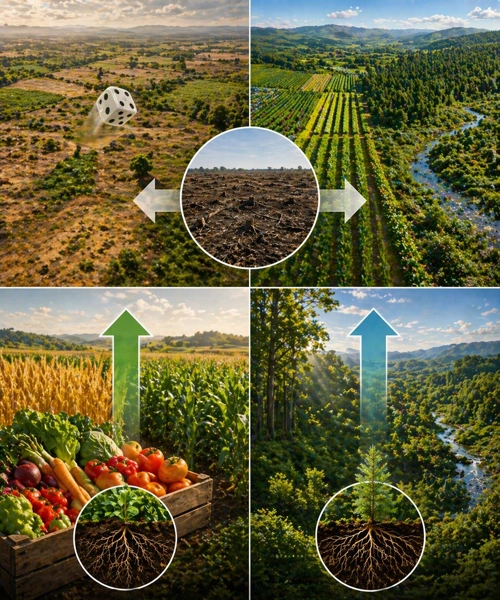
So the optimization problem is not “food versus climate versus nature” in the abstract sense.
Rather, it comes down to:
*On this specific plot of land, which use provides the greatest net value for society and the planet?*
Without spatial prioritization, freed land may be:
- Captured for speculative plantations,
- Left to degrade,
- Reused in ways that recreate old problems.
What does all this mean?
Changing the way we eat and moving from a meat-based diet to one based on plants can be rendered meaningless if we do not have:
- Zero-deforestation laws,
- Plans for protecting and restoring freed land,
- Barriers against uncontrolled bioenergy expansion,
…then freed land may be used for something just as harmful.
Political move: Every national “protein transition” strategy should be accompanied by an explicit and targeted “freed land strategy”.
How can this happen? – here, for better or worse, states must get involved.
National land-use priorities must be defined, and perhaps not only national, but continental ones as well.
States must answer explicitly:
How much of the preserved land should be used for:
- Food security (additional crops)
- Ecosystem restoration
- Rewilding and protected areas
- Bioenergy (if any at all)
Where and how should each use be located?
This becomes part of:
- Nationally Determined Contributions (NDCs)
- National Biodiversity Strategies and Action Plans (NBSAPs)
- Land-use and rural development plans
Prioritizing valuable nature
Some land freed from agriculture overlaps with:
- Biodiversity hotspots
- Forest frontiers
- Riparian corridors
These should be priority areas for:
- Rewilding
- Natural forest recovery
- Connectivity between protected areas
Work on rewilding shows that this often provides more resilience benefits than simple tree-planting schemes, especially on land that historically was not dense forest.
Freed land should be used for food where it matters most.
Not every region needs the same balance. In regions with insecure food security:
- Reusing part of the freed land for sustainable, diverse crop-growing systems is essential.
In countries with high food surplus:
- More of the freed land can be dedicated to restoration and biodiversity.
Optimization depends on context.
Care must be taken with large-scale bioenergy.
Bioenergy from abandoned land can:
- Help decarbonize energy systems,
- Support rural economies.
But if uncontrolled, it can:
- Undermine biodiversity,
- Compete with food,
- Recreate monoculture problems.
So it should be:
- Limited
- Carefully zoned
- Used mainly where it displaces the dirtiest fossil fuels and where biodiversity value is lower.