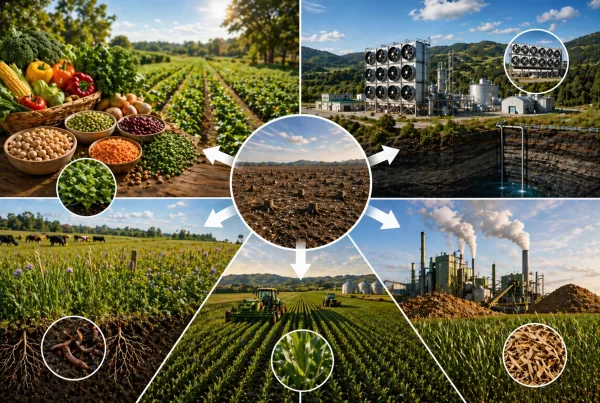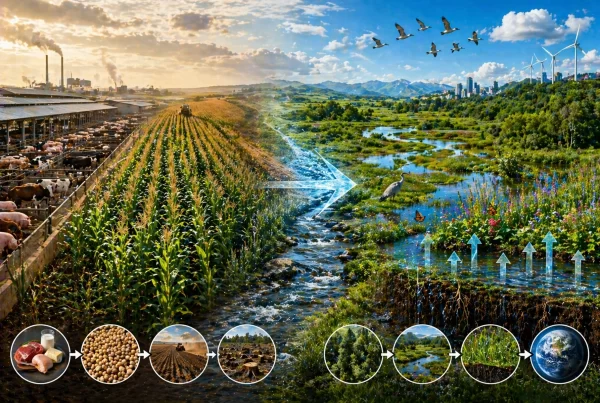

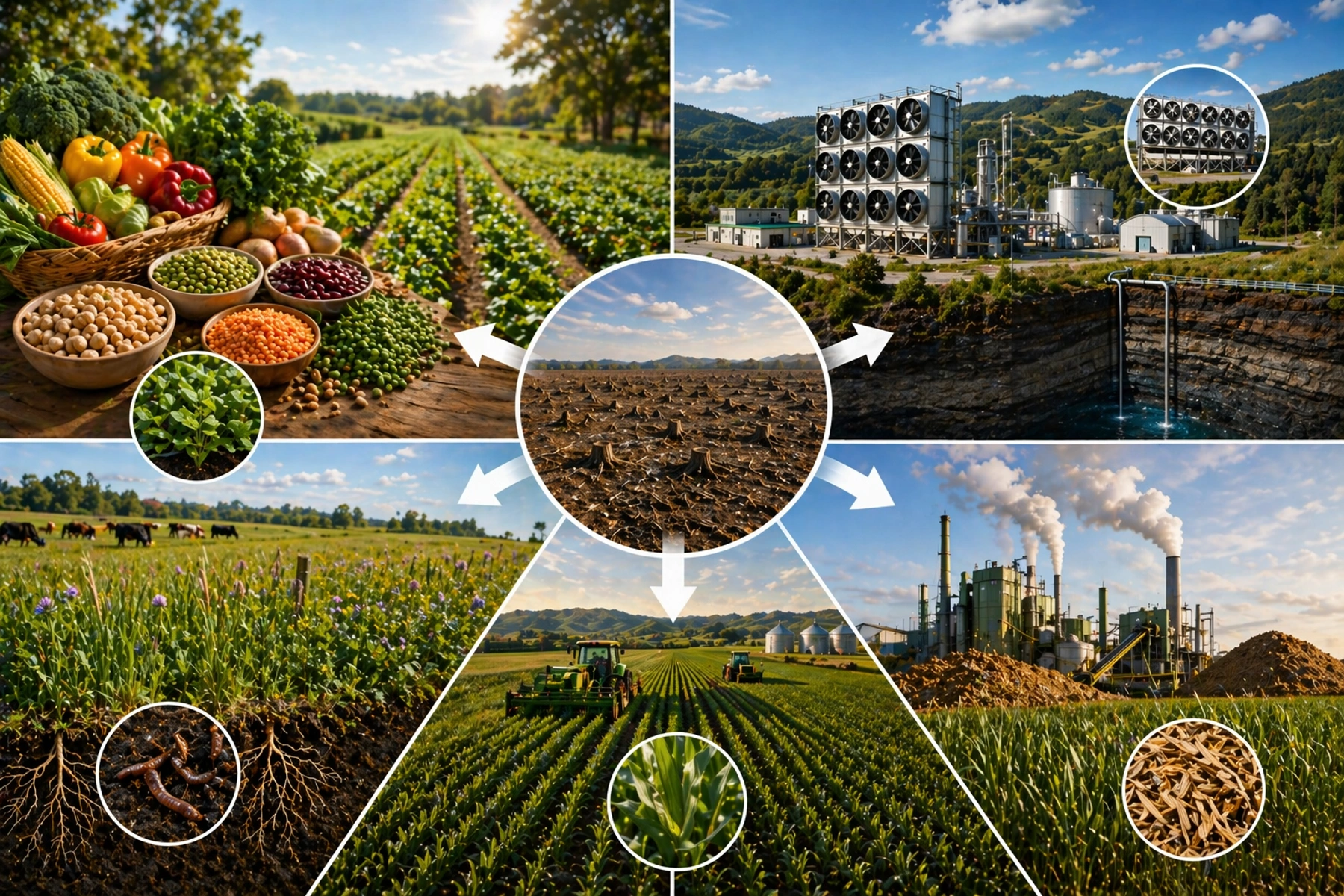
- Dietary change is the most effective move
- It gives the highest return
- It frees land and reduces emissions
- Land restoration amplifies the effect
- Regenerative agriculture is a useful helper
- Yield improvements need strict policies
- BECCS is expensive and risky
- DAC and CCS are needed, but the most expensive
- Food must be part of climate policy
- Freed land is a strategic resource
- The best approach is food plus restoration
- The biggest benefits come from systemic change
In the first article on the topic, we looked at different methods for improving the picture in terms of carbon emissions and what each of them represents. In this continuation, we will compare them in terms of efficiency and look at different options for action.
Return of the models
Which method has the highest return on investment and is the most effective relative to the area used?
Let us rank them approximately along two axes.
Mitigation per hectare or another unit of land (if used properly)
- Dietary change + land restoration
- Reduces emissions from livestock and frees land for afforestation/rewilding.
- Potentially 1–3 Gt CO₂/year of capture plus ~2 Gt CO₂e/year fewer emissions in the central scenario of the substitution study.
- Climate-focused afforestation/rewilding (on abandoned land)
- High carbon value + high biodiversity value, but it requires land to be freed in some way.
- BECCS on dedicated land
- High theoretical CO₂ removal per hectare, but serious conflicts with food + nature.
- Regenerative agriculture
- Solid, but lower mitigation per hectare; more important for resilience and soil health.
- Yield improvements
- Can be high per hectare if and only if paired with strict land-sparing policy; otherwise unclear.
Mitigation per dollar (very approximate, conceptual ranking)
We will arrange them from cheapest to most expensive on average:
- Dietary change
- The main costs are social/political; infrastructure costs are low.
- Co-benefits, such as healthcare savings, can make net costs negative.
- Regenerative agriculture / smart nitrogen management
- Often cheap or profitable; modest, but real climate impact.
- Yield improvements with land sparing
- Investments are needed, but many of them are already underway; climate benefits depend on policy design.
- BECCS
- Expensive and complex; land- and capital-intensive; moderate cost per ton compared with DAC, but high systemic risk.
- DAC / technological CCS
- Essential for some roles, but currently the most expensive climate lever per ton, especially DAC.
How should policies be prioritized?
Since dietary change ranks first in both classifications, it is desirable (not only because this is the idea of our site) for it to become one of the main policies within climate strategy.
This:
- Would reduce carbon emissions cheaply compared with the other options
- Frees land
- Allows large-scale land restoration
- Improves biodiversity and health
But it needs:
- Changes in public attitudes
- Climate-aligned dietary guidelines
- Support for farmers in the transition toward production of plant-based food products
- Support for plant-based meat imitation products and whole plant foods
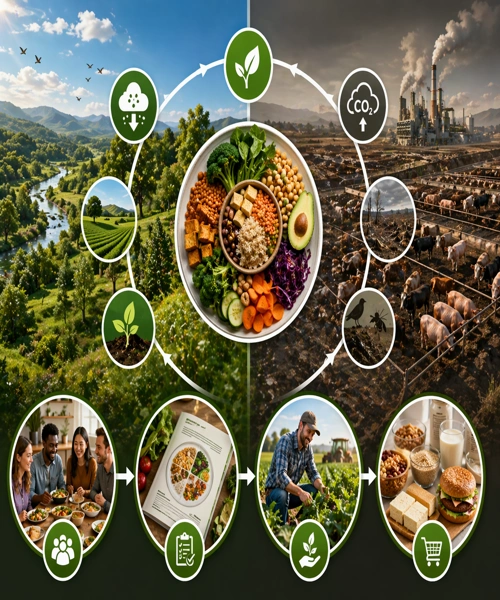
Treating freed land as a strategic asset
Every emissions reduction that frees land (dietary change, yield increases) must be paired with:
- Zero-deforestation policies
- Restoration/rewilding plans
- Clear zoning for which land goes to food, which to forests, and which to limited bioenergy
Otherwise, the benefits are easily lost.
Using regenerative agriculture as a “low-harm helper”
The following can be introduced:
- Cover crops
- Reduced tillage
- Better manure/nitrogen management
What can be expected:
- Moderate climate benefit
- Major resilience and soil benefits
As a conclusion from the comparison of the different climate-supporting methods, we can say that:
Integrating food and land into climate planning would bring positive results for achieving the set goals.
National and global climate plans (NDCs, long-term strategies) should preferably:
Explicitly model:
- Diet scenarios
- Land release thanks to yield improvements
- Restoration trajectories
And then compare:
“What if we spend X billion on the transition to plant-based food products and rewilding, versus the same money on BECCS + DAC?”
In many cases, food + restoration will be:
- Cheaper
- Faster
- More stable
- More broadly beneficial
Sources:
https://www.nature.com/articles/s41467-023-41837-y
https://ourworldindata.org/environmental-impacts-of-food
https://ourworldindata.org/food-choice-vs-eating-local
https://www.science.org/doi/10.1126/science.aaq0216
https://www.oecd.org/content/dam/oecd/en/publications/reports/2022/09/meat-protein-alternatives_54e42940/387d30cf-en.pdf
https://www.nature.com/articles/s41467-023-41407-6
https://www.nature.com/articles/s41467-023-41407-6.pdf
https://pubmed.ncbi.nlm.nih.gov/39242882/