
- Industrial pig farming causes systemic suffering
- Sows live under severe restriction
- Crates block natural behavior
- Piglets endure painful procedures without anesthesia
- Overcrowded conditions increase stress and aggression
- The lack of a proper environment leads to behavioral deprivation
- Pigs are intelligent and highly social animals
- Health problems are common and predictable
- Transport and slaughter add severe distress
- The problem is built into the system itself
- More humane alternatives exist
- Change requires a systemic approach
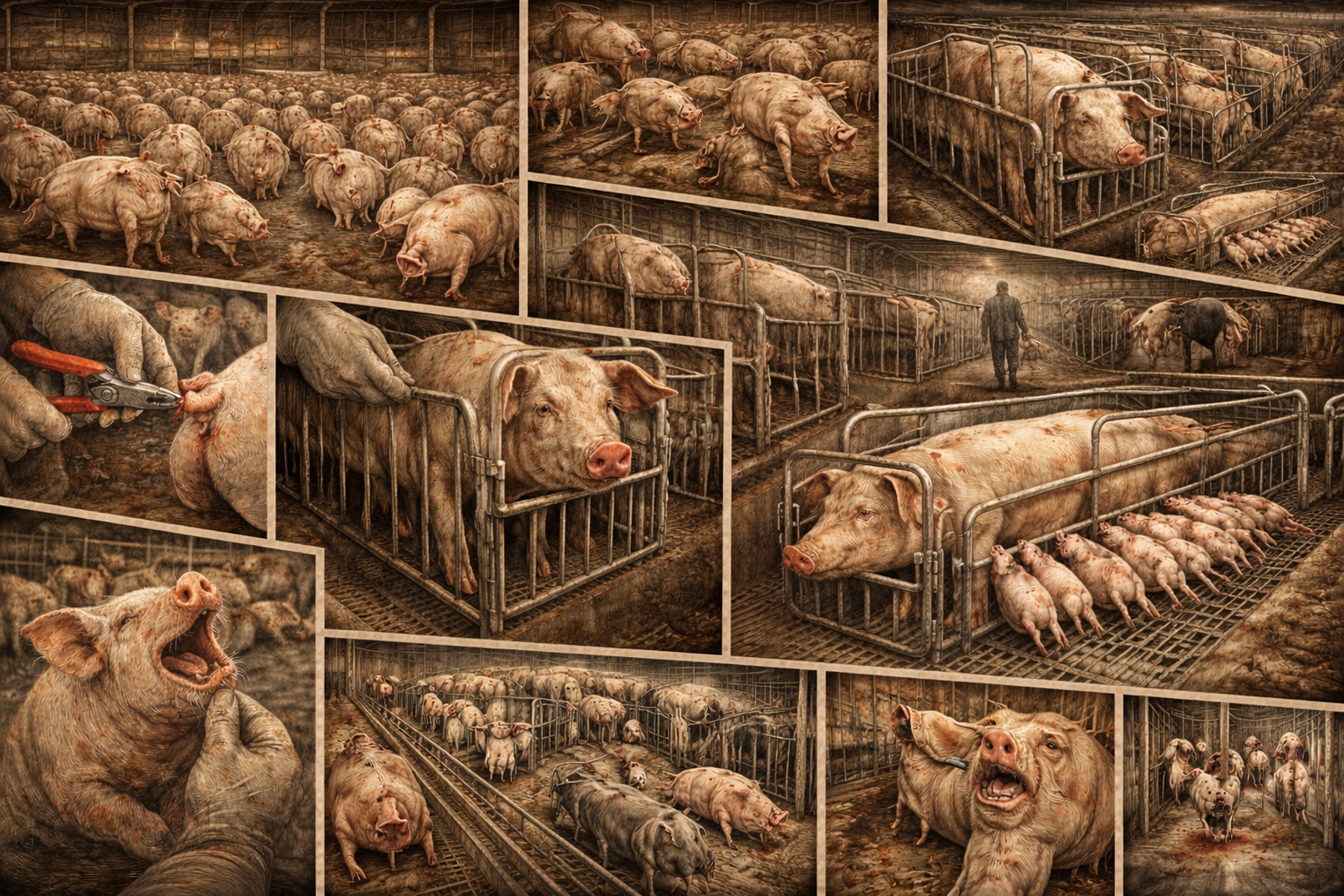
Industrial pork production is often hidden behind the image of pigs walking freely around open farms. The reality is completely different. Today, most pigs are raised in overcrowded indoor systems, confined in restrictive metal crates and subjected to painful procedures — routinely and without pain relief.
According to the Humane Society of the United States, Compassion in World Farming and numerous scientific reviews, pig farming is one of the most intensive and welfare-compromising sectors in modern agriculture.
This article examines the full life cycle of pigs in industrial systems — focusing on confinement, mutilations, behavioral deprivation and transport before slaughter.
Sows: Life in gestation and farrowing crates
Gestation crates: Complete immobility
Gestation crates confine pregnant sows — adult female pigs — in metal stalls so narrow that they cannot turn around and can barely take a step forward or backward. The crate is usually around 0.6 m × 2.1 m.
Sows remain in these crates for up to 4 months of each pregnancy.
The consequences for the animals’ condition include:
- prolonged physical discomfort
- muscle atrophy and poor joint health
- wounds from contact with metal bars
- inability to avoid aggression or engage in social interaction
- chronic frustration and stress
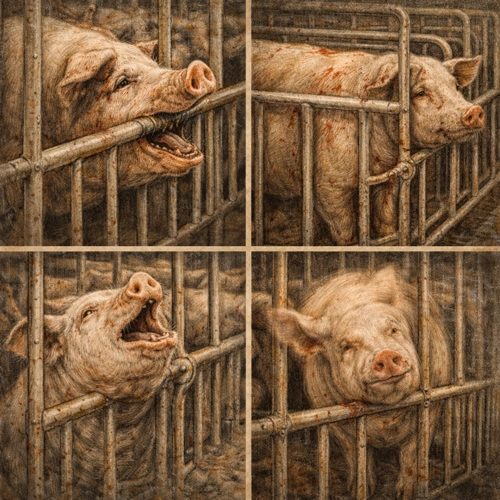
Behavioral signs include chronic stereotypies such as bar biting, sham chewing and repeated head movements — indicators of psychological distress.
Farrowing crates: Restriction during birth
Shortly before giving birth, sows are moved into farrowing crates, which again severely restrict movement. These crates are intended to reduce piglet crushing, but they create serious welfare problems:
- Sows cannot build a nest — a deeply motivated behavior before giving birth.
- Limited space restricts changes in posture during nursing.
- Piglets often experience temperature stress without adequate bedding.
Pigs, being highly intelligent and social animals, suffer long-term mental and physical harm in both systems.
Piglets: Routine mutilations without pain relief
Within a few days of birth, piglets undergo several painful procedures — usually without anesthesia or analgesia. These “routine mutilations” are considered standard practice in industrial operations.
Tail docking
The piglet’s curly tail is removed using a hot blade or clippers.
Purpose: to prevent tail biting in overcrowded and restricted environments.
Result for the animal’s condition: acute pain, which can lead to the formation of chronic neuromas causing long-term sensitivity.
Castration
Male piglets are often surgically castrated to prevent “boar taint” in the meat.
This involves cutting the scrotum and removing the testicles — usually without pain relief.
Tooth clipping
Piglets’ needle teeth are clipped or ground down to reduce injuries caused by competition within litters.
This can expose the dental pulp, leading to long-term pain or infection.
Ear notching/marking
Performed for identification, often with sharp cutting tools.
Scientific reviews consistently conclude that these procedures cause immediate and prolonged pain responses, including squealing, escape attempts and behavioral changes.
Growing and fattening pigs: Crowded, barren environments
After weaning, pigs are moved into indoor facilities with concrete or slatted floors. CIWF and HSUS describe these conditions as:
- overcrowded
- barren — no straw, no rooting materials
- noisy, stressful and socially unstable
Under normal conditions, pigs like to:
- dig
- explore
- manipulate objects
- engage in play
Industrial systems deny these behaviors.
Aggression and stress
Overcrowded pens and the lack of any proper living conditions lead to increased aggression, often resulting in:
- skin lesions
- bitten ears and tails
- stress-related weakening of the immune system
Scientific research shows that barren, confined systems trigger harmful behaviors that are not observed in enriched or outdoor systems.
Air quality problems
Ventilation is crucial, but ammonia, dust and humidity often reach harmful levels. Effects include:
- respiratory disease
- eye irritation
- increased incidence of pneumonia
Behavioral deprivation: A central welfare problem
Pigs are among the most cognitively and emotionally complex farm animals. They:
- form social structures
- play
- learn from one another
- explore new objects
- have excellent long-term memory
Industrial systems block the expression of these behaviors.
This leads to behavioral abnormalities such as:
- tail biting
- chewing metal barriers
- repetitive movements
- learned helplessness
These signs reveal chronic frustration and psychological suffering, not merely boredom.
Health problems in industrial pig farming systems
Common welfare-related health problems in piglets and pigs include:
- lameness from hard flooring
- joint and hoof disease
- gastrointestinal disease caused by stress and poor hygiene
- respiratory infection
- skin lesions from fighting
- high piglet mortality due to crushing or hypothermia
Industrial efficiency prioritizes rapid growth and high productivity over animal health.
Transport and slaughter: Final high-stress stages
Transport exposes pigs to:
- long journeys
- extreme temperatures
- overcrowding
- rough handling and electric prods
Scientific evidence shows that stress hormones rise significantly during transport. Handling injuries — bruises, fractures and abrasions — are common.
At slaughter, CO₂ stunning, widely used for pigs, causes:
- fear
- respiratory distress
- aversive behavior
This remains one of the most criticized stunning methods from an animal welfare perspective.
Why these problems are structural, not accidental
Across pork production systems, the same pattern of animal treatment appears:
Confinement leads to behavioral frustration, which causes aggression/disease and routine mutilations, and in the end we get chronic suffering.
This pattern appears not because farmers are cruel, but because industrial systems are designed for:
- high stocking density
- reproductive control
- rapid growth
- cost minimization
CIWF and scientific reviews agree:
Animal welfare problems are systemic — meaning they arise from the structure of industrial production, not from isolated poor management.
What alternatives look like
Although no commercial system is perfect, several improvements can improve welfare:
For sows
- group housing instead of gestation crates
- larger farrowing pens with enrichment
For growing pigs
- straw or compost bedding
- manipulable enrichment materials
- lower stocking density
- outdoor or deep-litter systems
For piglets
- ending routine tail docking
- analgesia/anesthesia for castration
- enriched environments that reduce natural tail biting
For all pigs
- improved ventilation and flooring
- more humane slaughter alternatives, as paradoxical as that may sound — research is ongoing
Countries such as Sweden, the United Kingdom and Switzerland have already banned gestation crates or farrowing crates, demonstrating that change is possible.
Industrial pork production relies heavily on confinement and painful procedures that seriously compromise pig welfare. From sows trapped in crates, to piglets mutilated without pain relief, to growing pigs denied natural behavior, these problems are not isolated incidents — they are built into the architecture of the system itself.
Understanding the depth of suffering endured by pigs is essential for informed consumer choices, humane policy development and the creation of alternatives that respect the behavioral and emotional needs of one of the most intelligent animals in agriculture.
Sources:
https://www.humanesociety.org/sites/default/files/docs/hsus-report-animal-welfare-industrial-agriculture.pdf
https://www.ciwf.org.uk/farm-animals/pigs/
https://www.ciwf.org.uk/farm-animals/pigs/sow-crates/
https://www.ciwf.org.uk/farm-animals/pigs/piglet-mutilations/
https://doi.org/10.1002/9781444302622