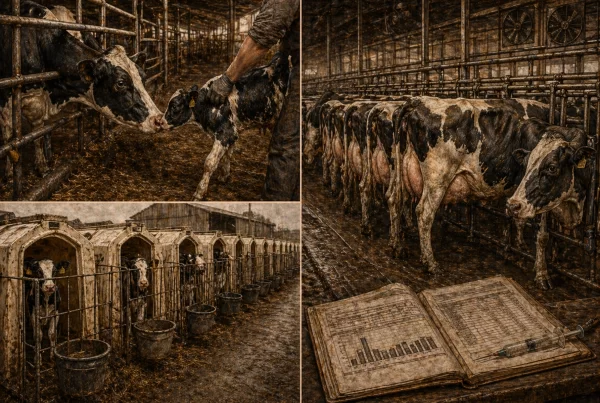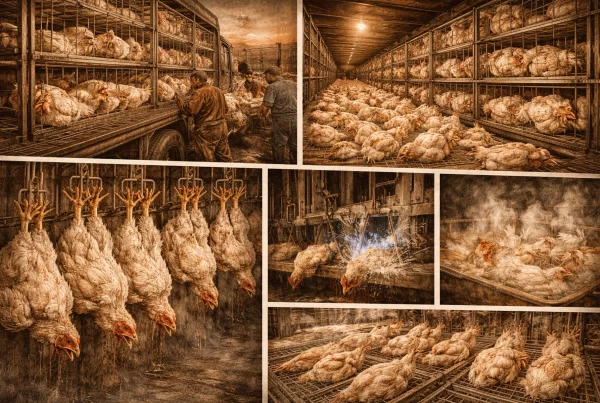


- The problems are built into the system itself
- The model is system → stress → harm
- Efficiency often comes at the expense of welfare
- Confinement creates chronic stress
- High density increases disease and aggression
- Genetic selection intensifies physiological pressure
- Poor environments lead to health and behavioral damage
- Suffering is measurable through health and behavior
- Good management does not solve the structural problem
- Freer systems produce better results
- Reforms are needed at the design level
- The root of the harm lies in the production model
In the previous articles from this category, we saw recurring animal welfare problems affecting different species in modern agriculture: lameness in broilers, confinement of sows in gestation crates, mastitis and metabolic stress in dairy cows, as well as intense stress during transport and slaughter for all of them.
At first glance, these problems may seem unrelated. Chickens suffer from rapid growth, pigs from confinement, cows from high milk production, and animals during transport from stress. However, animal welfare science reveals a deeper pattern: these problems arise from the very structure of the production system.
Researchers increasingly describe this pattern using a conceptual framework that can be summarized as:
System → Stress → Harm
This model helps explain why similar welfare problems appear across different species and production systems.
The scientific literature, summarized by the Humane Society of the United States, Compassion in World Farming and the World Organisation for Animal Health, highlights how industrial design choices systematically generate welfare risks.
Understanding the “System → Stress → Harm” framework
Scientists working in animal welfare — as out of place as that may sound in this context — often evaluate production systems by identifying the environmental or management factors that create welfare challenges.
The framework can be simplified as follows:
Stage Description
System Design of the production environment
Stress Conditions created by that system
Harm Physical or psychological suffering experienced by the animals
This model shifts attention away from isolated incidents and toward the structural features of production systems.
Instead of asking:
“Is this farm poorly managed?”
Researchers ask:
“Does the system itself create unavoidable welfare risks?”
System design: Efficiency as the main goal
Industrial animal farming systems are developed to maximize:
- feed efficiency
- labor efficiency
- economic output
As a result, many design features prioritize production rather than the treatment of animals.
Examples include:
- high stocking density
- closed housing systems
- specialized genetic breeding
- large centralized slaughterhouses
These systems reduce costs and increase food supply, but they often restrict animals’ natural behavior and physical comfort.
Stress factors created by industrial systems
Once a production system is designed, it generates specific environmental stress factors.
Confinement
Systems such as battery cages, gestation crates and tie stalls severely restrict movement.
This leads to:
- muscle weakness
- bone fragility
- inability to perform natural behaviors
High stocking density
High stocking density increases:
- aggression
- disease transmission
injuries caused by trampling
Genetic selection
Breeding animals for productivity can create physiological stress.
Examples include:
- broilers bred for rapid growth, which develop skeletal disorders
- dairy cows bred for high milk yield, which causes metabolic stress
Environmental conditions
Poor ventilation, concrete floors and lack of enrichment can lead to:
- respiratory disease
- lameness
- behavioral abnormalities
- These stress factors occur consistently on many farms using similar production models.
Resulting harm to animals
When animals are exposed to constant stress factors, measurable welfare harms appear. Animal welfare science usually evaluates these harms through outcome-based indicators.
Examples include:
- physical health indicators
- lameness in cattle and broilers
- mastitis in dairy cows
- skin lesions in pigs
- respiratory disease in poultry
Behavioral indicators
- stereotypic behavior — bar biting, repetitive movements
- aggression
- abnormal social behavior
- inactivity caused by pain
Physiological indicators
- elevated cortisol levels
- immunosuppression
- increased mortality
These indicators show that animals experience chronic stress or suffering.
Why management alone cannot solve these problems
A common response to criticism of animal welfare conditions is the claim that better farm management can solve welfare problems.
Although good management certainly improves outcomes, the systemic model suggests that management improvements alone cannot eliminate structural stress factors.
For example:
- A well-maintained battery cage still prevents nesting and perching.
- A carefully managed gestation crate still prevents turning around.
- A properly ventilated overcrowded broiler house still restricts movement.
In these cases, the welfare limitation comes from the design of the housing system, not from poor management.
Evidence from animal welfare research
Scientific welfare assessments often compare different production systems.
In many studies, systems that allow greater behavioral freedom consistently show improved animal-based welfare indicators.
Examples include:
- cage-free systems instead of battery cages for hens
- group housing instead of gestation crates for pigs
- pasture access instead of full confinement for dairy cows
Animals in these systems usually show:
- improved physical health
- lower stress hormone levels
- more natural behavioral expression
This evidence supports the idea that animal welfare outcomes depend strongly on system design.
Why industrial systems continue to exist
Despite welfare concerns, industrial systems remain dominant because they offer several advantages for their owners:
Economic efficiency
Large-scale operations reduce production costs and increase output.
Consistency and control
Controlled indoor environments allow precise management of feed, temperature and growth rates.
Global food supply
Industrial agriculture provides large quantities of affordable animal products.
However, these benefits must be weighed against the animal welfare challenges the systems create.
Moving toward system-level solutions
Recognizing that problems arise from system design changes the approach to improving animal welfare.
Instead of focusing only on individual farms, researchers increasingly emphasize system-level reforms, such as:
- replacing extreme confinement systems
- reducing stocking density
- breeding animals with a focus on health rather than maximum output
- providing environmental enrichment
- redesigning housing environments
These changes address the root causes of welfare problems rather than their symptoms.
The welfare challenges observed in modern animal agriculture are not isolated events. They are predictable outcomes of production systems designed primarily for efficiency and high output.
The “System → Stress → Harm” model provides a clear way to understand why similar welfare problems appear across different species and farming systems. By recognizing the structural origin of these problems, policymakers, scientists and producers can focus on reforms that improve animal welfare at the level where it matters most: the design of the system itself.
Sources:
https://www.humanesociety.org/sites/default/files/docs/hsus-report-animal-welfare-industrial-agriculture.pdf
https://www.ciwf.org.uk/research/
https://www.ciwf.org.uk/farm-animals/
https://www.ciwf.org.uk/farm-animals/chickens/
https://www.ciwf.org.uk/farm-animals/pigs/
https://www.ciwf.org.uk/farm-animals/cows/
https://www.woah.org/en/what-we-do/standards/codes-and-manuals/terrestrial-code-online-access/
https://www.woah.org/fileadmin/Home/eng/Health_standards/tahc/current/chapitre_aw_transport_land.pdf
https://www.woah.org/fileadmin/Home/eng/Health_standards/tahc/current/chapitre_aw_slaughter.pdf