
- LDL is a major risk factor
- Saturated fats increase LDL
- Trans fats are the most harmful
- HDL supports reverse transport
- Red and processed meat increase risk
- Plant-based diets lower LDL
- Soluble fiber actively helps
- Plant sterols limit absorption
- Movement and weight loss improve the profile
- High LDL is a global health problem
- Cardiovascular risk is strongly linked to LDL
- Nutrition is key to controlling it
Nowadays, one of the major problems for people in the Western world is obesity and cholesterol. You might say, “Thank you for telling us, we had no idea,” but since the trends show that the picture is becoming increasingly dark — or in this case increasingly fluffy and overweight — it seems that the topic still needs attention, and in this article we will do exactly that.
Most of us know that cholesterol can be something good, because it allows us to produce hormones that are important for us. But when we have too much of it — and lately most of us do have too much of it — it begins to settle comfortably in different places in the body and interfere with its normal function, and sometimes it even presses the shutdown button.
In this article, we will look at the types of cholesterol, what their function is, which foods they are found in, and what we can do to improve the overall condition of our bodies.
When people say “cholesterol,” they are actually talking about lipoproteins — particles that carry fats through the blood. There are two main types of cholesterol —LDL cholesterol, which we describe as bad, and HDL cholesterol, which plays the role of the good guy in this case.
LDL cholesterol — “Bad cholesterol”
LDL = Low-density lipoprotein
Why is it considered bad?
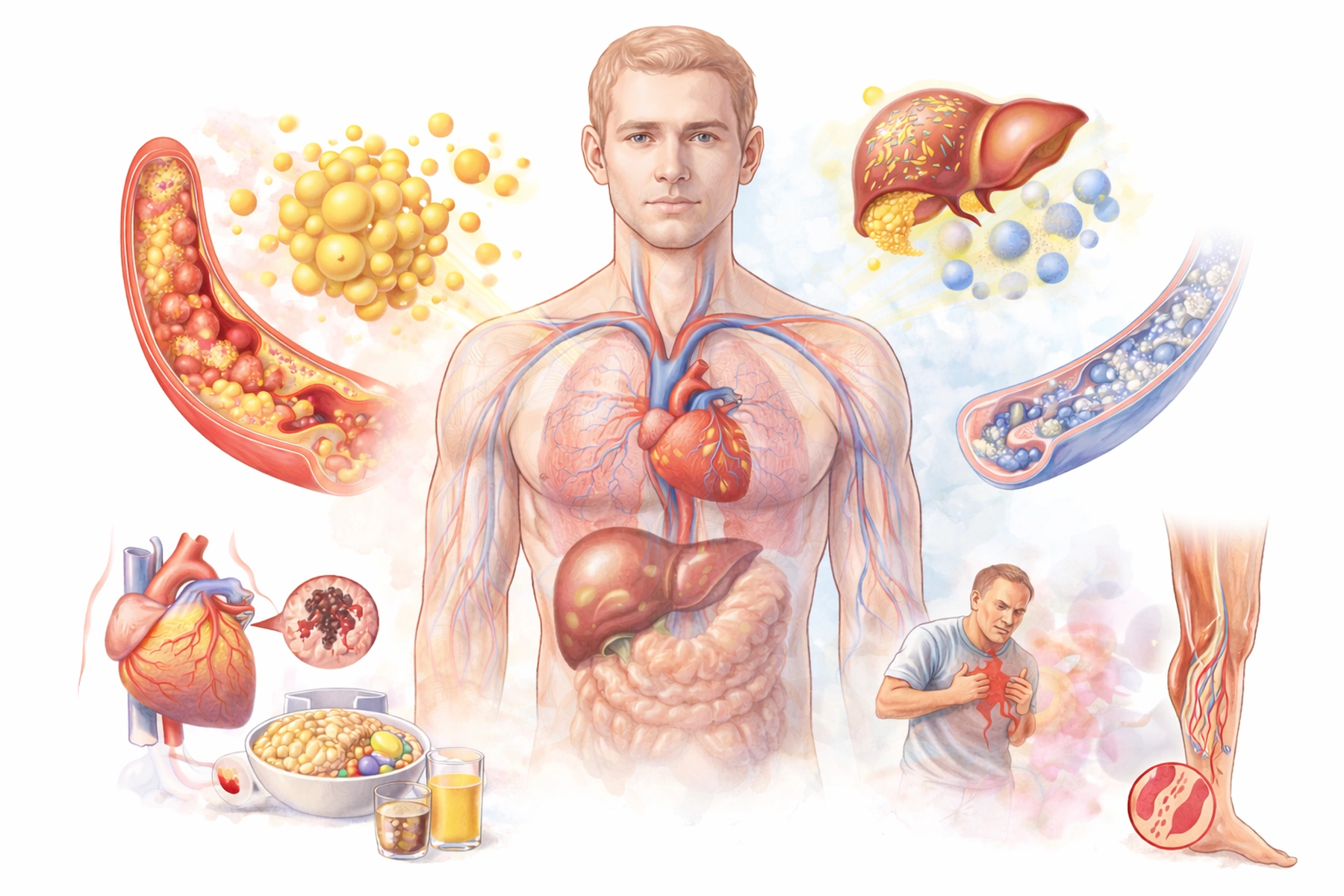
The job of LDL is to deliver cholesterol, or in other words the necessary fats, to the cells. When there is too much LDL, it begins to:
- Penetrate the walls of the arteries
- Trigger inflammation
- Form plaque (atherosclerosis)
- Cause the accumulation of cholesterol, immune cells, and scar tissue inside the arteries
- Narrow or block arteries, leading to:
- heart attacks (blocked coronary arteries)
- strokes (blocked brain arteries)
In other words, LDL is a direct cause of heart disease. And whether we like it or not, this cause-and-effect relationship is one of the most strongly established in medicine.

Now that we have clarified what damage LDL cholesterol can cause when it is present in large amounts, let us see where it comes from.
Contrary to popular belief, we do not absorb LDL directly from food. Instead, certain foods increase LDL production by the liver.
Foods that raise LDL the most:
Saturated fats
They significantly raise LDL. They are found mainly in:
- Red meat (beef, pork, lamb)
- Processed meat (sausages, salami, bacon)
- High-fat dairy products (cheese, butter, whole milk)
- Lard / animal fats
- Coconut oil and palm oil (plant sources, but still high in saturated fat)
Dietary cholesterol
It is found only in animal products.
It raises LDL much less than saturated fat, but it still has an effect in some people.
Foods high in dietary cholesterol:
- Eggs, especially yolks
- Chicken meat
- Milk, cheese, butter
- Shellfish (shrimp, lobster)
Trans fats (the worst of all)
They dramatically raise LDL and lower HDL.
They are found in:
- hydrogenated oils
- fast food fried in old oil
- some pastries, cookies, margarine, less common now because of regulations
HDL cholesterol — “Good cholesterol”
HDL = High-density lipoprotein
Why is it considered good?
- HDL helps clear excess cholesterol.
- It collects cholesterol from the blood and artery walls
- It delivers it back to the liver
- It reduces the risk of plaque accumulation
Higher HDL is associated with a lower risk of cardiovascular disease — but artificially increasing HDL does NOT reduce risk, which is an important nuance.
This means that HDL is more of a marker of healthy metabolism than a direct protective mechanism.

Foods that affect HDL
Although you can influence HDL a little, this is harder than lowering LDL.
Things that moderately raise HDL:
- Physical exercise
- Weight loss, if you are overweight
- Nuts, seeds, olive oil (unsaturated fats)
- Avocado
- Omega-3 (flaxseed, chia, walnuts, fatty fish)
- Moderate alcohol intake, but it is not recommended as therapy
Meat consumption, LDL, and heart risk
Red and processed meats tend to raise LDL because they are rich in:
- Saturated fats
- Dietary cholesterol
- Heme iron, which contributes to oxidative stress
- Carnitine/choline → can be converted into TMAO (a compound produced in your body when certain nutrients from animal foods are metabolized by gut bacteria), associated with higher cardiovascular risk because it accelerates plaque growth in the arteries
Why meat-free diets reduce the amount of the bad guy, LDL
Plant-based diets:
✔ contain almost no dietary cholesterol
✔ are naturally lower in saturated fat
✔ are richer in soluble fiber (beans, oats, fruit), which pulls LDL out of the blood
✔ contain plant sterols, which block cholesterol absorption
✔ direct the body toward more efficient cholesterol use
Human studies show that LDL usually drops by:
- 10–30% with well-designed vegetarian/vegan diets
- even more when whole foods replace processed foods
Harms caused by cholesterol
A few statistics about the damage LDL cholesterol causes globally:
High LDL cholesterol is consistently identified as one of the leading modifiable risk factors contributing to the burden and frequency of cardiovascular disease worldwide.
Nearly 80% of global disability and death from cardiovascular disease, measured as DALYs — years of life lived with some disability — is attributable to modifiable risk factors such as high LDL, high blood pressure, and poor diet.
Deaths and harm attributable to high LDL cholesterol
According to data from the Global Burden of Disease study, worldwide deaths are as follows:
In 2019, ~4.4 million deaths were caused by elevated LDL cholesterol.
– This represents an increase of about 46% compared with 1990, when there were around 3.0 million deaths.
Disability and total burden
High LDL cholesterol is responsible for a large number of DALYs, which combine premature death and years lived with disability.
For example, estimates show ~98.6 million DALYs worldwide in 2019 due to high LDL cholesterol.
Heart diseases linked to high LDL levels (ischemic heart disease)
Most diseases caused by high LDL cholesterol are due to ischemic heart disease (IHD) — the type caused by blockages from plaques in the coronary arteries.
In 2019, more than 85% of deaths and DALYs attributable to high LDL cholesterol were linked to IHD (ischemic heart disease), with the remainder linked to stroke and other conditions.
Share of cardiovascular disease attributable to high LDL (percentage contribution)
Although the exact percentage contribution varies depending on population and age, studies show:
In some age groups, especially middle-aged people, the share of cardiovascular disease attributable to high LDL — called the population attributable fraction (PAF) — can reach ~80% for ischemic heart disease.
(This means that up to 80% of IHD cases in that group were statistically associated with high LDL.)
Increase in health risk because of LDL levels
Large meta-analyses show a clear relationship between amounts and consequences, namely:
Higher LDL levels are associated with an increased risk of death from cardiovascular disease (CVD). One pooled analysis found that for each standard increase in LDL, there is a significantly higher risk of death from cardiovascular causes.
Global context: Cardiovascular diseases are the leading cause of death
Cardiovascular diseases cause a total of around 18 million deaths per year worldwide, representing approximately one third of all deaths.
High LDL is one of the main modifiable factors behind this enormous global burden.
In conclusion — LDL is a bad friend to our body because it increases the risk of heart disease. Its levels in our body are increased by: saturated fats, trans fats, and dietary cholesterol. Foods that contain them include red meat, processed meat, cheese, butter, coconut oil, and eggs.
At this point, we also turn our attention to its opponent in the ring — HDL. It takes care of returning cholesterol to our liver, and its level can be increased slightly by physical activity, nuts, and olive oil.
Foods that can help us obtain the macronutrients we want without raising our LDL levels are:
- Beans and lentils
- Oats and barley
- Apples, berries, citrus fruits (soluble fiber)
- Nuts, seeds
- Soy foods
- Olive oil
- Olive oil
- Whole grains
In the next article, we will introduce you in more detail to the close relationship between eating patterns and LDL cholesterol levels.
Additional sources:
Sources:
https://pmc.ncbi.nlm.nih.gov/articles/PMC9424500/
https://www.frontiersin.org/journals/cardiovascular-medicine/articles/10.3389/fcvm.2022.903126/full
https://pubmed.ncbi.nlm.nih.gov/36051998/
https://www.sciencedirect.com/science/article/pii/S1875213624006703
https://www.who.int/health-topics/cardiovascular-diseases